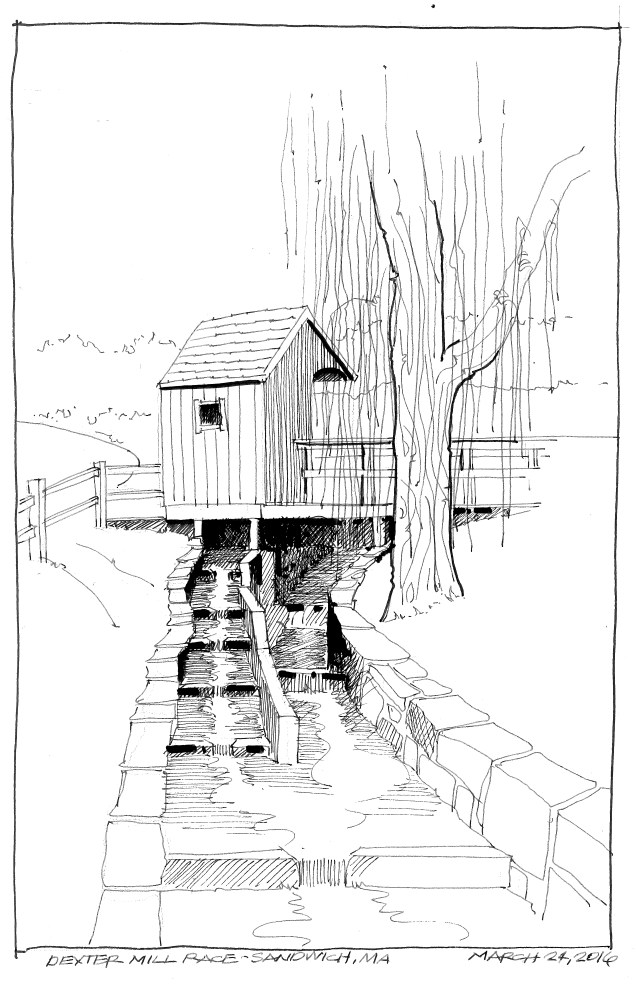
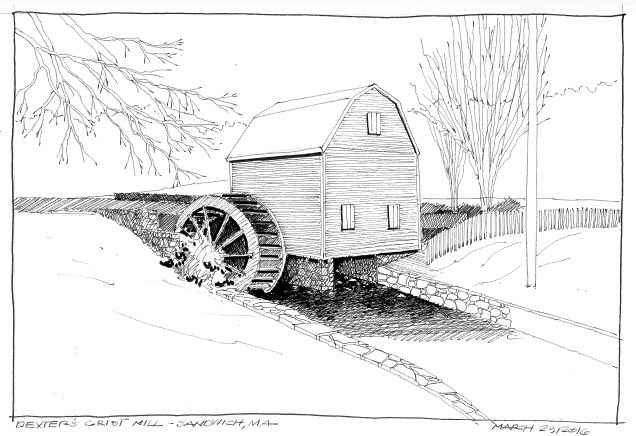
Dexter’s Grist Mill

One of the oldest water mill sites existing in the United States today, Dexter’s Grist Mill, has Plymouth Colony Records dating back to 1640 in which Thomas Dexter was allocated 26 acres and 6 acres for his mill. In 1856 a new mill building replaced the old woolen mill and manufactured marble stone products. An iron turbine replaced the wooden waterwheel in Dexter’s Mill in 1856.The gristmill last operated in 1881 when Captain Laban Crocker was miller. In 1961 Dexter’s Mill was restored with authentic wooden parts and an undershot wooden waterwheel. The millstones were imported from France. The mill and mill grounds are well preserved. Dexter’s Mill sits on the dam, which creates a beautiful, large millpond. The meandering millrace is lined in cut stone. The foundation of the three-story building is laid in cut stone with an undershot wooden waterwheel on the east side. The mill building is sided with natural shake. Lamy fountain pen with Noodler’s Black Ink in a Stillman and Birn sketchbook.

2016-03-23 Dexters Grist Mill

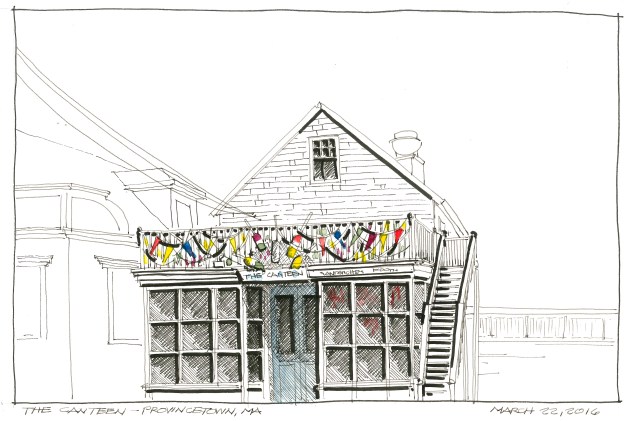
The Canteen

The Canteen is located in Provincetown, Massachusetts and is a casual New England eatery that uses high-quality ingredients to create Cape Cod favorites from scratch. The menu and style of service is rooted in the tradition of classic seafood shacks, but influenced by modern American cuisine. Housed in a 200 year-old building, the communal dining room opens onto the bustle of downtown Provincetown while the backyard seating area opens out onto Cape Cod Bay. The building caught my eye with the colorful flags and lobster buoys on the second floor balcony railing. Lamy safari fountain pen with Noodler’s black ink and Holbein watercolors in a Stillman and Birn sketchbook.

2016-03-22 The Canteen

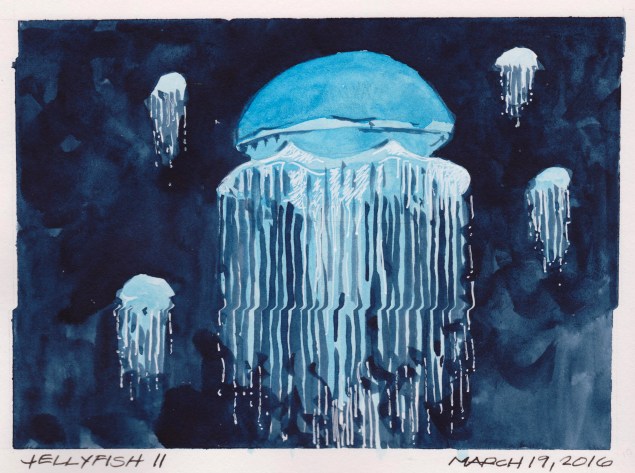
Jellyfish III

A continuation of the Jellyfish and Ocean theme.

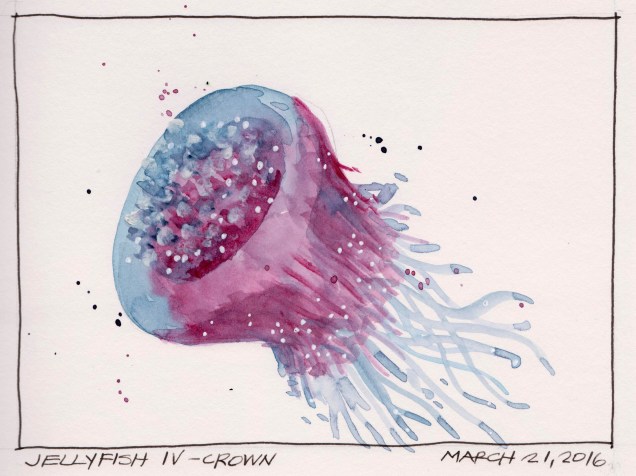
Crown Jellyfish are distinguished from other jellyfish by the presence of a deep groove running around the umbrella, giving them the crown shape from which they take their name. Many of the species in the order inhabit deep sea environments. Crown jellyfish are able to make light through bioluminescence. When they are touched, their bells will light up. Otherwise, the bell of a crown jellyfish will look transparent when undisturbed. When they are attacked, crown jellyfish are able to startle, mislead, and distract their predators with the light that they produce.The sketch is  direct to watercolor without ink. Holbein and Daniel Smith watercolors in a Stillman and Birn sketchbook.
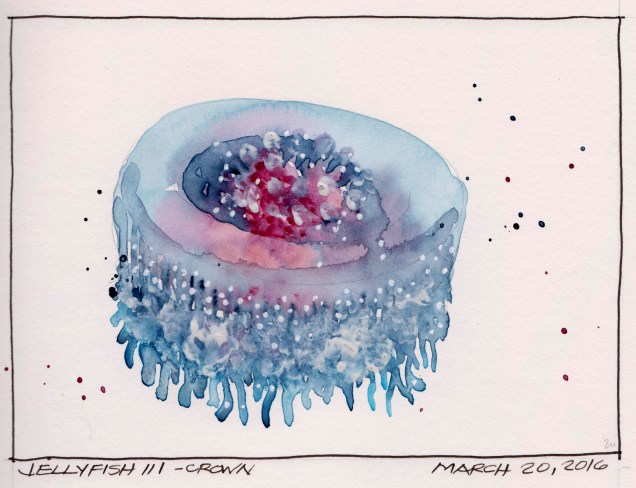
2016-03-20 Jellyfish III

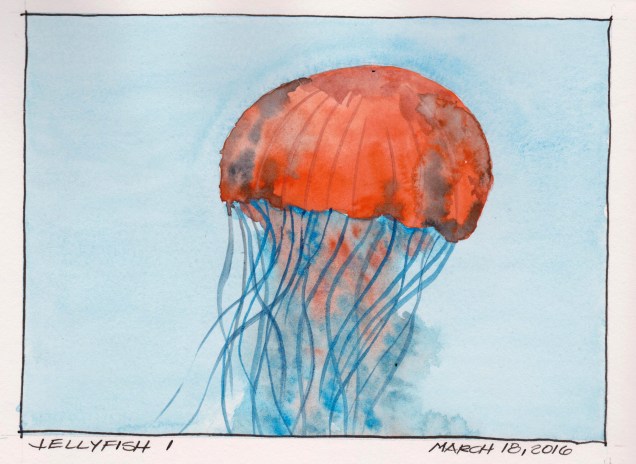
Jellyfish I

First of a week series of Jellyfish to get back to the ocean theme. They are typified as free-swimming marine animals consisting of a gelatinous umbrella-shaped bell and trailing tentacles. The bell can pulsate for locomotion, while stinging tentacles can be used to capture prey. Jellyfish are found in every ocean, from the surface to the deep sea. Large, often colorful, jellyfish are common in coastal zones worldwide. Jellyfish have roamed the seas for at least 500 million years, and possibly 700 million years or more, making them the oldest multi-organ animal. The sketch is  direct to watercolor without ink. Holbein and Daniel Smith watercolors in a Stillman and Birn sketchbook.
2016-03-18 Jellyfish I

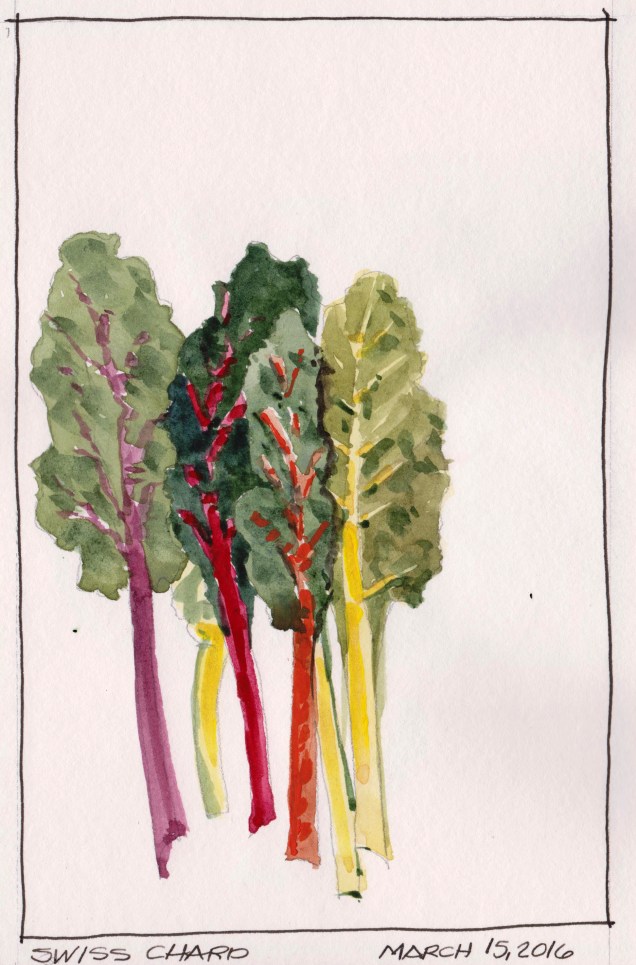
Swiss Chard

A continuation of fruit and vegetables series completed with a quick proportion pencil sketch and then watercolor with no ink. Swiss Chard is a leafy green vegetable often used in Mediterranean cooking. In the Flavescens-Group-cultivars, the leaf stalks are large and are often prepared separately from the leaf blade. The leaf blade can be green or reddish in color; the leaf stalks also vary in color, usually white, yellow, or red. Chard has highly nutritious leaves making it a popular addition to healthful diets. Chard has been used bt cooks for centuries. Daniel Smith and Holbein watercolors in a Stillman and Birn sketchbook.
2016-03-15 Swiss Chard

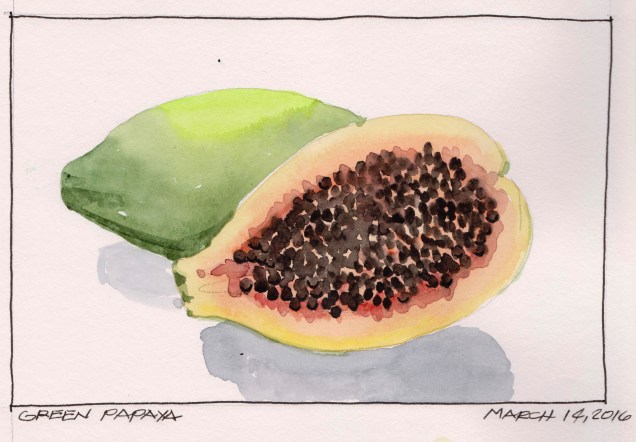
Green Papaya

A continuation of fruit and vegetables series completed with a quick proportion pencil sketch and then watercolor with no ink. The papaya, papaw or pawpaw  is the fruit of the plant Carica Papaya, and is one of the 22 accepted species in the family. It is native to the tropics of the Americas from southern Mexico and neighboring Central America.  It was first cultivated in Mexico several centuries before the emergence of the Mesoamerican classical civilizations. The papaya is a large, tree-like plant, with a single stem growing from 5 to 10 m (16 to 33 ft) tall, with spirally arranged leaves confined to the top of the trunk. The lower trunk is conspicuously scarred where leaves and fruit were borne. The leaves are large, 50–70 cm (20–28 in) in diameter with seven lobes.  The fruit appear on the axils of the leaves, maturing into large fruit – 15–45 cm (5.9–17.7 in) long and 10–30 cm (3.9–11.8 in) in diameter. The fruit is a type of berry. It is ripe when it feels soft (as soft as a ripe avocado or a bit softer) and its skin has attained an amber to orange hue. Daniel Smith and Holbein watercolors in a Stillman and Birn sketchbook.
2016-03-14 Green Papaya