Asparagus

Asparagus is a herbaceous, perennial plant growing to 39–59 inches tall, with stout stems with much-branched, feathery foliage. The “leaves” are in fact needle-like cladodes (modified stems) in the axils of scale leaves; they are 0.24–1.26 inches long and 1 mm (0.039 in) broad, and clustered four to 15 together, in a rose-like shape.  Theflowers are bell-shaped, greenish-white to yellowish, with six tepals partially fused together at the base; they are produced singly or in clusters of two or three in the junctions of the branchlets. It is usually dioecious, with male and female flowers on separate plants, but sometimes hermaphrodite flowers are found. Pilot Falcon fountain pen with Noodler’s Black ink and Holbein watercolors in a Stillman and Birn sketchbook.
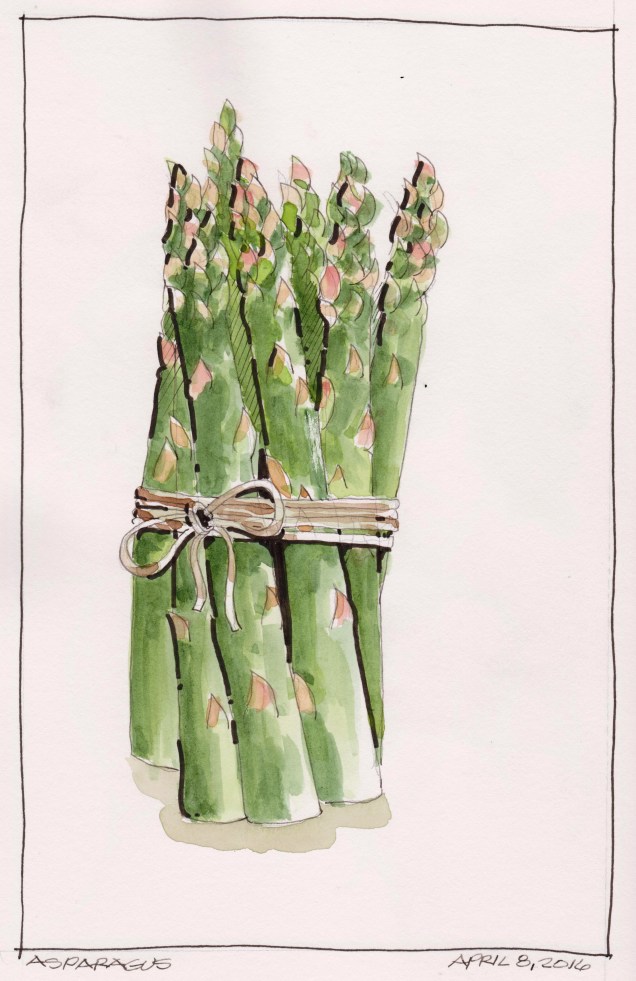
2016-04-08 Asparagus

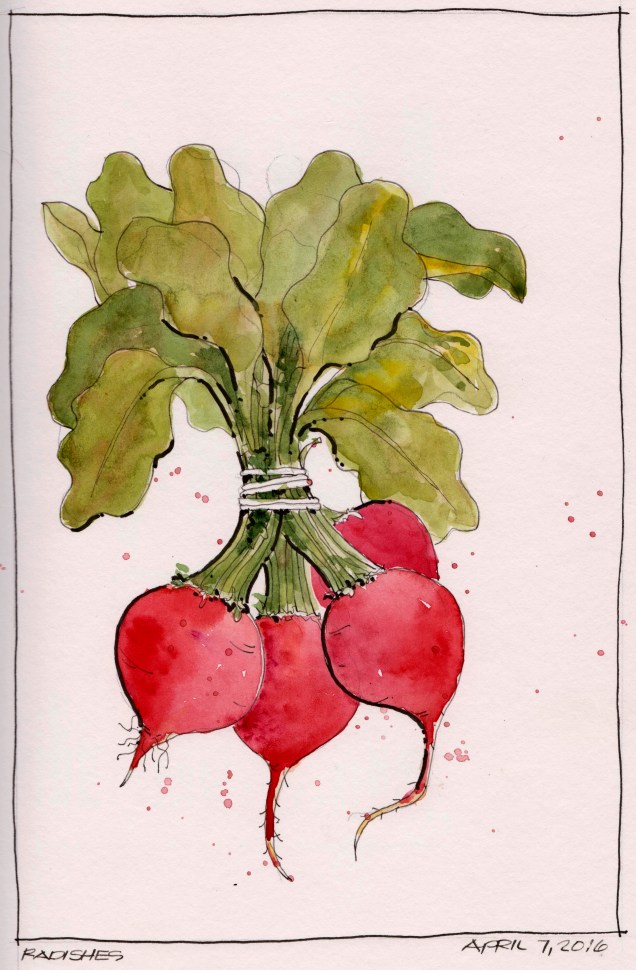
Radishes

The Radish is an edible root vegetable that was domesticated in Europe in the pre-Roman times. Radishes are grown and consumed throughout the world, being mostly eaten raw as a crunchy salad vegetable. They have numerous varieties, varying in size, flavor, color, and length of time they take to mature. Radishes of spicy varieties owe their sharp flavor to the various chemical compounds produced by the plants. They are sometimes grown as companion plants and suffer from few pests and diseases. They germinate quickly and grow rapidly, smaller varieties being ready for consumption within a month, while larger daikon varieties take several months. Another use of radish is as cover or catch crop in winter or as a forage crop. Pilot Falcon fountain pen with Noodler’s Black ink and Holbein watercolors in a Stillman and Birn sketchbook.
2016-04-07 Radishes

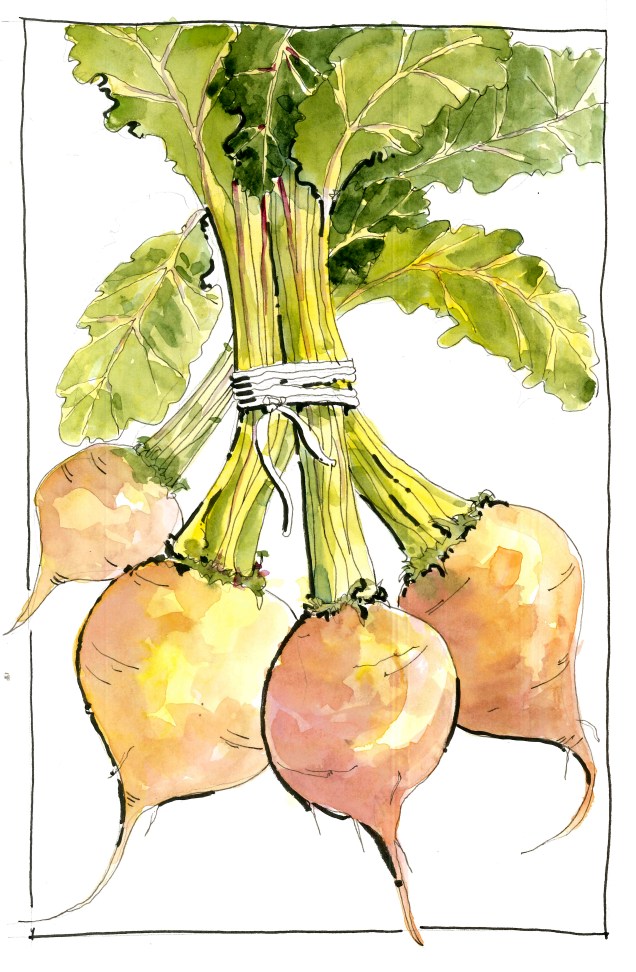
Golden Beets

Another variety of the beetroot. This sketch is of the Golden Beet which is a beautiful golden yellow in the inside and tastes like it’s more familiar cousin, the purple beet. It is several of the cultivated varieties grown for their edible taproots and their leaves (called beet greens). Other than as a food, beets have use as a food coloring and as a medicinal plant. Pilot Falcon fountain pen with Noodler’s black ink and Holbein watercolors in a Stillman and Birn sketchbook.

2016-04-6 Golden Beets

Purple Beets

The beetroot is the taproot portion of the beet plant, usually known in North America as the beet, also table beet, garden beet, red beet or golden beet. It is several of the cultivated varieties grown for their edible taproots and their leaves (called beet greens). Other than as a food, beets have use as a food coloring and as a medicinal plant. Pilot Falcon fountain pen with Noodler’s black ink and Holbein watercolors in a Stillman and Birn sketchbook.

2016-04-05 Purple Beets


Carrots

The carrot is a root vegetable, usually orange in colour, though purple, black, red, white, and yellow varieties exist.It has a crisp texture when fresh. The most commonly eaten part of a carrot is a taproot, although the greens are sometimes eaten as well. It is a domesticated form of the wild carrot, native to Europe and southwestern Asia. The domestic carrot has been selectively bred for its greatly enlarged and more palatable, less woody-textured edible taproot. Pilot Falcon fountain pen with Noodler’s Black Ink and Holbein watercolors in a Stillman and Birn sketchbook.

2016-04-04 Carrots

It is not Spring yet

Just when it is starting to look and feel like spring, we get a light snow to let us and our flowers know that spring is not here yet. The Daffodils look so sad almost in full blown bent over with the weight of the snow. The advantage is that this time of year, the snow melts quickly with the higher snow angles. Pilot Falcon fountain pen with Noodler’s black ink and Holbein/Daniel Smith watercolors in a Stillman and Birn.

2016-04-03 Daffodils in the Snow