Foxglove

The Foxglove Flower is native to western and southwestern Europe, western and central Asia and northwestern Africa. The scientific name means “finger-like” and refers to the ease with which a flower of Digitalis purpurea can be fitted over a human fingertip. The flowers are produced on a tall spike, are tubular, and vary in colour with species, from purple to pink, white, and yellow.  This biennial plant is often grown as an ornamental plant due to its vivid flowers which range in colour from various purple tints through various shades of light gray, and to purely white. The flowers can also possess various marks and spottings. Holbein watercolors on Fluid 100, 140# cold press watercolor paper.
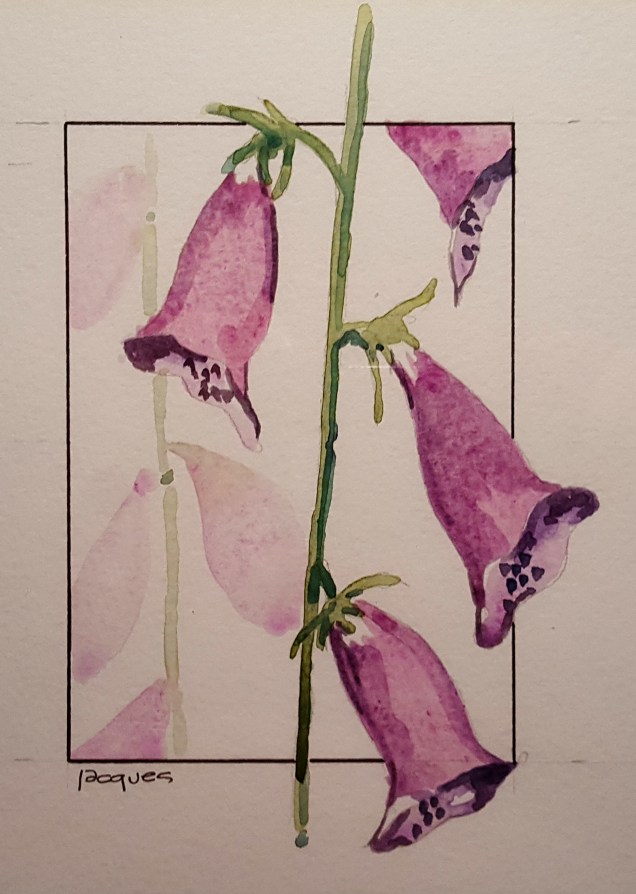
2016-12-28-foxglove

Poinsettia

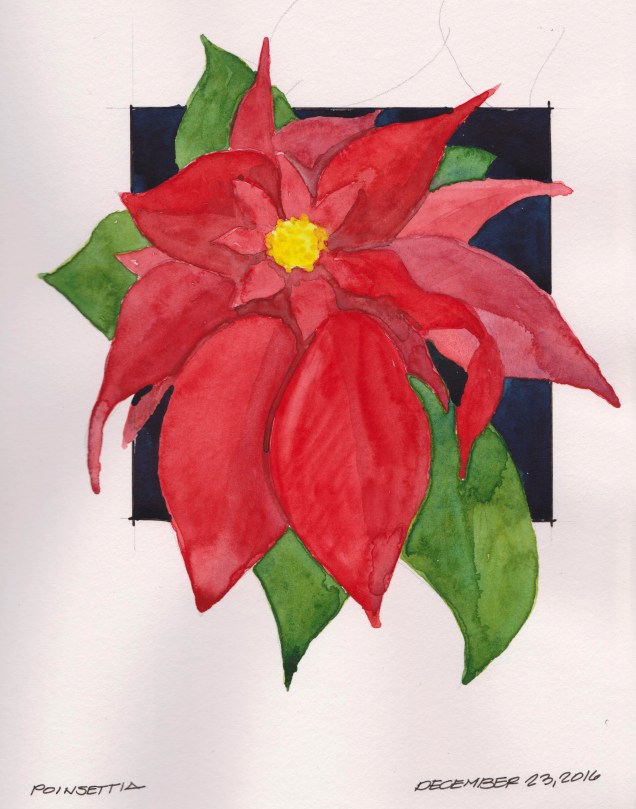
2016-12-23-poinsettiaThe poinsettia is a commercially important plant species of the diverse spurge family. The species is indigenous to Mexico. It is particularly well known for its red and green foliage and is widely used in Christmas floral displays. It derives its common English name from Joel Roberts Poinsett, the first United States Minister to Mexico, who introduced the plant to the US in 1825. Holbein and Daniel Smith watercolors in a Stillman and Birn Beta sketchbook. Merry Christmas.
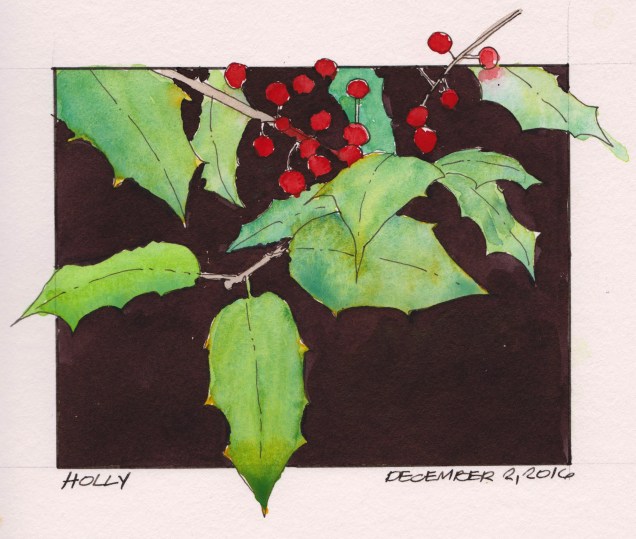
 

Holly

With the last of the fall leaves, comes the change of season over to winter and the thoughts of Christmas. We have 6-8 natural Holly Trees in our yard that were here when we built our house. The largest is probably 30′ tall. This one must be a male in that it does not produce berries. Pilot Falcon fountain pen with Noodler’s Bulletproof black ink, Holbein watercolors and a background wash of Mont Blanc black ink.

2016-12-02-holly

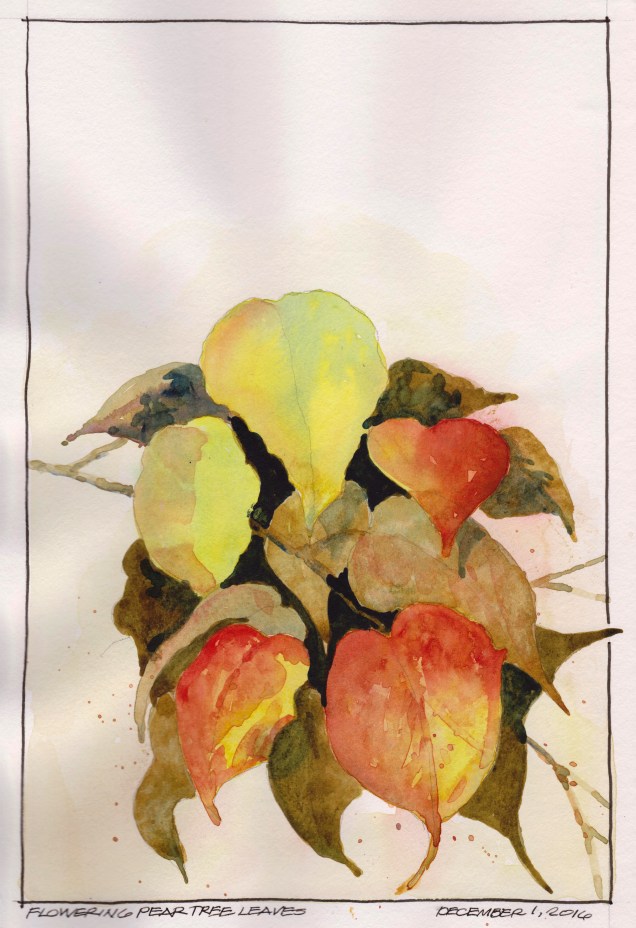
Flowering Pear Leaves

Our last tree to realize that it is Autumn. The leaves on the Flowering Pear Tree are just turning now after almost all of the other trees have lost their leaves and are ready for winter. These leaves still have some of the of the green and are turning yellow with some red highlights. Holbein watercolors in a Stillman and Birn Beta sketchbook.

2016-12-01-pear-tree-leaves

Stage Harbor Light House

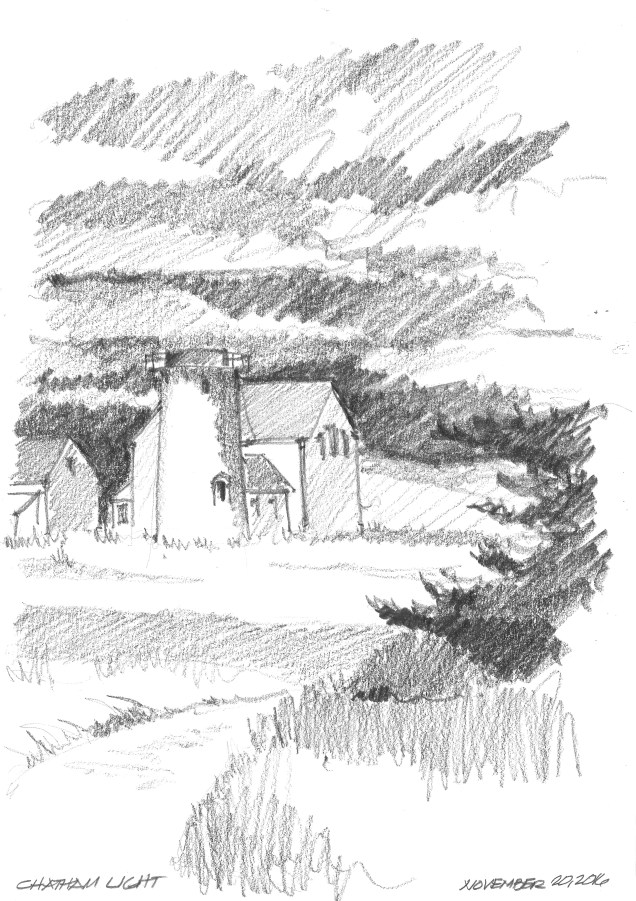
We went for a beach walk today as we try to do year round on weekends. Stage Harbor Light is at the end of Harding’s Beach in Chatham, Massachusetts. It was a could day with drizzle, but I think this view could work into a studio painting. Stage Harbor Light is the most recent lighthouse built on Cape Cod and the lantern was removed in 1933. Graphite in a Stillman and Birn sketchbook.

2016-11-20-chatham-light

Falmouth Harbor

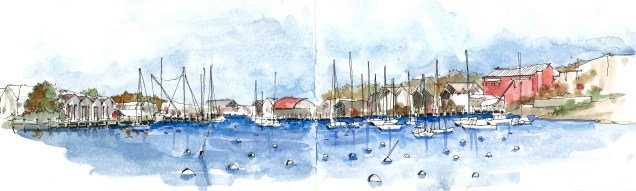
A beautiful Autumn Sunday afternoon in Falmouth, Massachusetts on Cape Cod. While Lisa walked Falmouth Heights, I sat in the car and sketched Falmouth Harbor. Still some boats left before they all get stored out of the water for the winter. Lamy fountain pen with Noodler’s Bulletproof black ink and Holbein watercolors in a Moleskine landscape watercolor sketchbook.

2016-11-13-falmouth-harbor

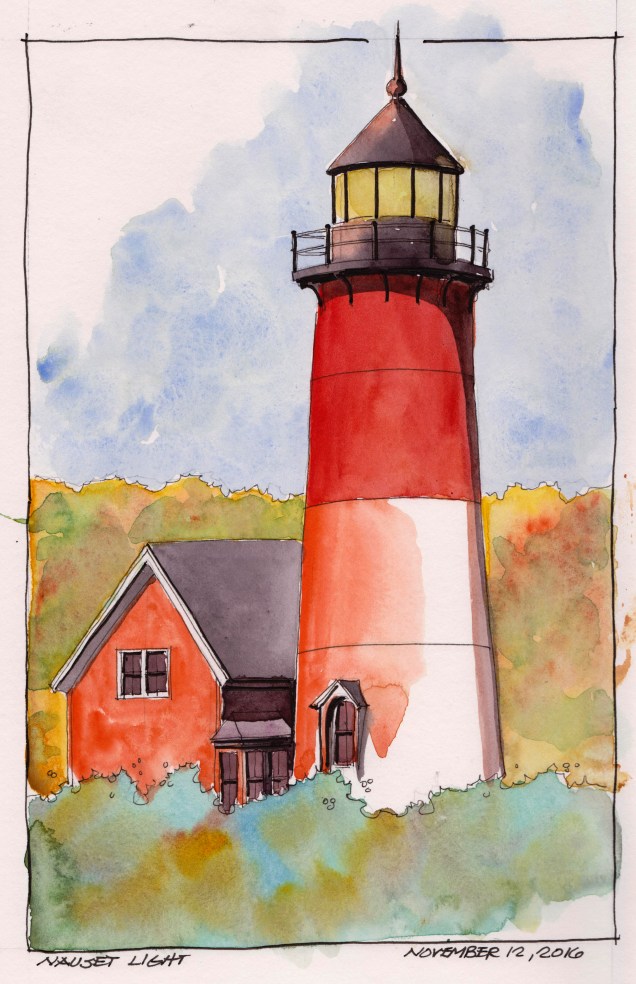
Nauset Light

Nauset Light was constructed in 1877 and was originally one of two lights in Chatham It was moved to Eastham in 1923 to replace the Three Sisters of Nauset, three small wood lighthouses that had been decommissioned. Nauset Light was originally all white, but in the 1940s was painted with the red section at the top, creating the iconic appearance of the lighthouse. The light was automated and the keeper’s house was sold in 1955. Due to coastal erosion, by the early 1990s Nauset Light was less than 50 feet from the edge of the 70-foot cliff on which it stood. In 1993, the Coast Guard proposed decommissioning the light. Following a great public outcry, the non-profit Nauset Light Preservation Society was formed and funded, and in 1995, it leased the lighthouse from the Coast Guard. The organization arranged for the light to be relocated, in November 1996, to a location 336 feet west of its original position – which by then was only 37 feet  from the cliff’s edge. Pilot Falcon fountain pen with Noodler’s Bulletproof black ink and Holbein watercolors in a Stillman and Birn Beta sketchbook.

2016-11-12-nauset-light

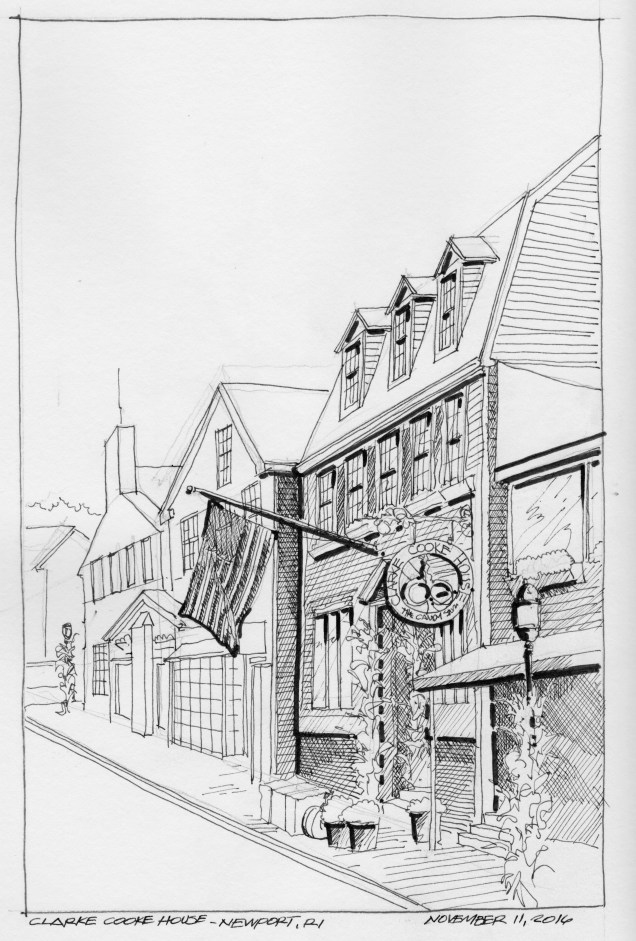
Clarke Cooke House

A beautiful fall afternoon to skip out of work early and head to one of our favorite places – Newport, Rhode Island. Autumn is the best time of year here, with the summer tourists one and a crisp coolness in the air. A wonderful sunset over the harbor tonight and this view of the Clarke Cooke House with the sun glowing on the side elevation.  In 1780, Clarke Cooke, a wealthy Newport sea captain built the house nearby on Thames Street before eventually moving from Thames Street as it commercialized. The second and third floors of the building are original (while the first had been used for various commercial purposes) and these top “floors were jacked up, moved and set on a new foundation, which is now the wharf level dining area.” Pilot Falcon fountain pen with Noodler’s Bulletproof black ink and Faber Castell Pitt Art pens in a Stillman and Birn Sketchbook.

2016-11-11-clarke-cooke-house