Beach Find

Walking on Harding Beach in Chatham, MA on Cape Cod, I came across a Horseshoe Crab washed up on shore. Horseshoe Crabs are invertebrates, meaning that they lack a spine and they live primarily in and around shallow ocean waters on soft sandy or muddy bottoms. The entire body of the horseshoe crab is protected by a hard carapace. Behind its legs, the horseshoe crab has book gills, which exchange respiratory gases, and are also occasionally used for swimming. As in other arthropods, a true endoskeleton is absent, but the body does have an endoskeletal structure made up of cartilaginous plates that support the book gills. They are more often found on the ocean floor searching for worms and mollusks, which are their main food. They may also feed on crustaceans and even small fish. Pilot Falcon Fountain Pen with Noodlers Bulletproof Black ink in a Stillman and Birn Beta Sketchbook.
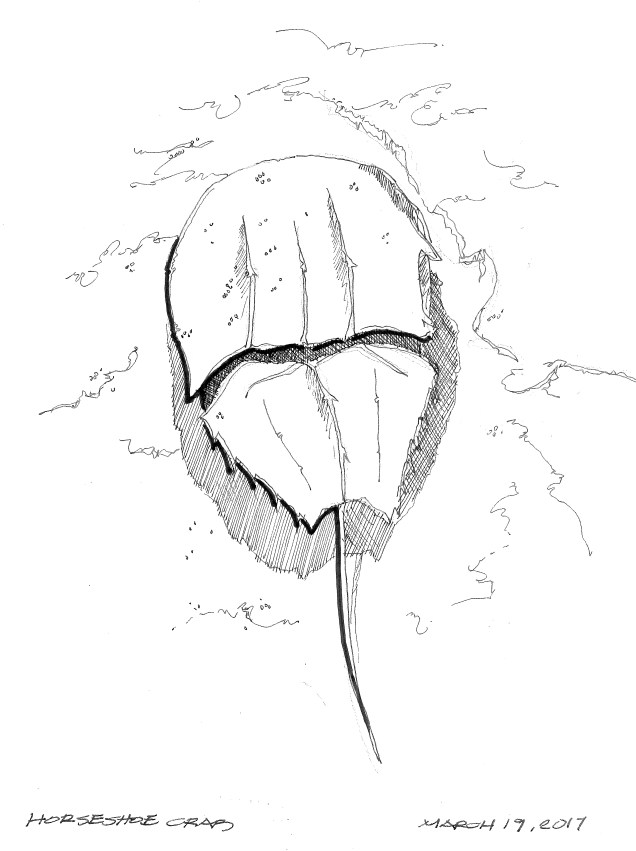
2017-03-19 Horseshoe Crab

Manhattan Bridge

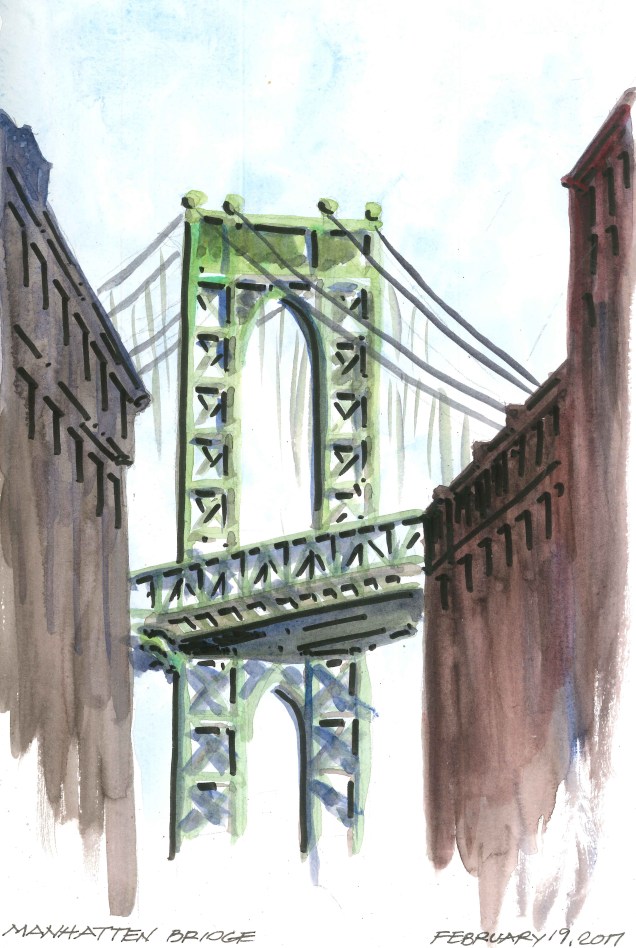
Another quick sketch from New York City. This is the view from the DUMBO neighborhood in Brooklyn. The bridge is framed by the old warehouses that are going through a renaissance. Pilot Falcon fountain pen with Noodler’s Bulletproof black ink and Holbein watercolors in a Stillman and Birn Alpha sketchbook.

2017-02-20-manahattan-bridge

Harding’s Beach

This watercolor is of a couple of dinghies pulled up on the sand at Harding’s Beach in Chatham on Cape Cod. This is our favorite walking beach in the winter. It is about a mile walk to the old Stage Harbor Lighthouse at the end of the beach protecting the entrance to Stage harbor. Holbein watercolors in a Stillman and Birn Beta sketchbook.

2017-01-22-hardings-beach

Chatham Fish Pier

The Chatham Fish Pier, is located at the corner of Shore Road and Barcliff Avenue on Aunt Lydia’s Cove. The members of the fishing fleet make their run each suitable day to the fishing grounds from 3 to 100 miles off Chatham. Their catch consists of haddock, cod, flounder, lobster, pollock, dogfish and halibut. The one-day fresh fish is placed in ice and transported in refrigerated trucks to the New York, Boston, New Bedford and local markets, reaching there less than 24 hours from the time it is taken from the ocean. The pier is rather quiet this time of year. Pilot Flacon fountain pen with Noodler’s Bulletproof black ink and Faber Castell Pitt Art pens in a Stillman and Birn Sketchbook.

2017-01-21-chatham-fish-pier

Chives

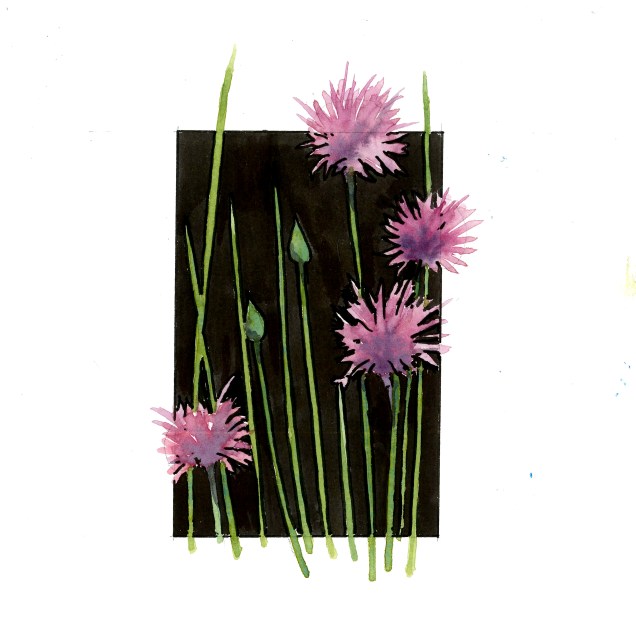
I miss our chive plants that have gone dormant for the winter and have been buried in snow for the past week.  The name of the species derives from the Greek σχοίνος, skhoínos (sedge) and πράσον, práson (leek). Its  English name, chives, derives from the French word cive, from cepa, the Latin word for onion. Chives are a commonly used herb and can be found in grocery stores or grown in home gardens. In culinary use, the scapes and the unopened, immature flower buds are diced and used as an ingredient for seasoning dishes. Chives have insect-repelling properties that can be used in gardens to control pests. The flowers area pale purple and star-shaped with six petals 1/2″ – 3/4″ wide, and produced in a dense inflorescence  of 10 – 30 together. Before opening, the inflorescence is surrounded by a papery bract. Holbein watercolors on 140# Fluid 100 cold press watercolor paper.

2017-01-12-chives