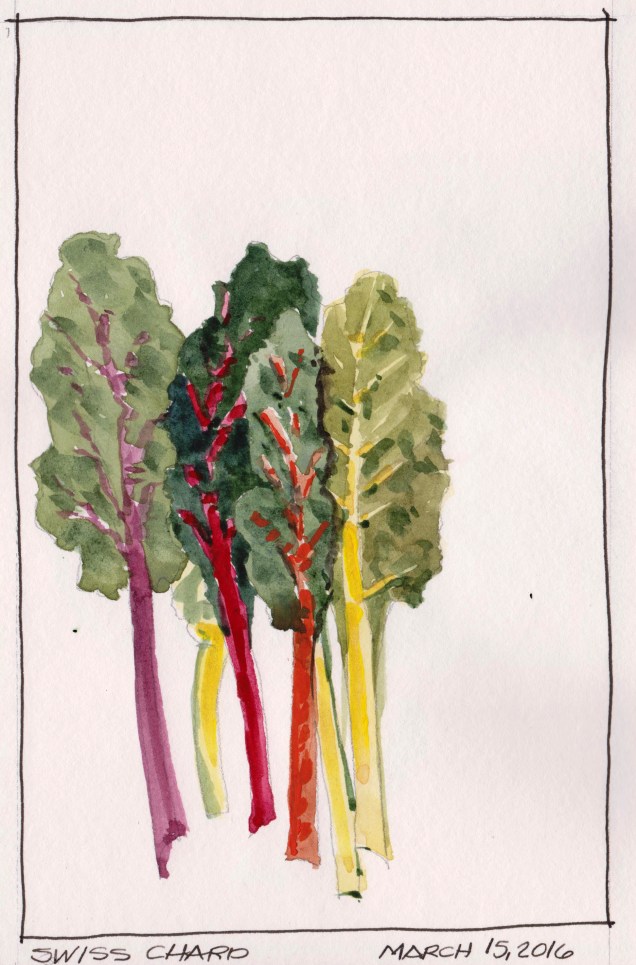
Swiss Chard

A continuation of fruit and vegetables series completed with a quick proportion pencil sketch and then watercolor with no ink. Swiss Chard is a leafy green vegetable often used in Mediterranean cooking. In the Flavescens-Group-cultivars, the leaf stalks are large and are often prepared separately from the leaf blade. The leaf blade can be green or reddish in color; the leaf stalks also vary in color, usually white, yellow, or red. Chard has highly nutritious leaves making it a popular addition to healthful diets. Chard has been used bt cooks for centuries. Daniel Smith and Holbein watercolors in a Stillman and Birn sketchbook.

2016-03-15 Swiss Chard

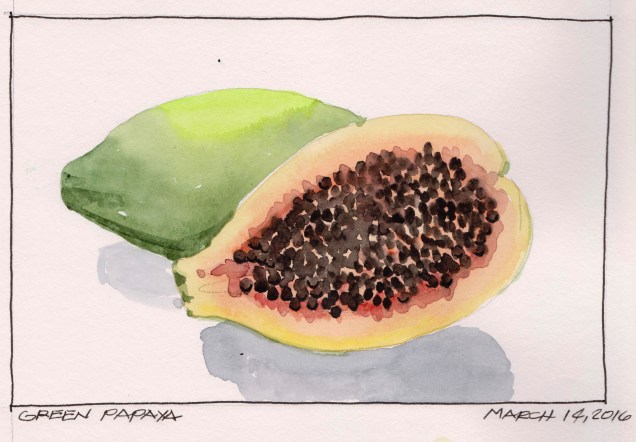
Green Papaya

A continuation of fruit and vegetables series completed with a quick proportion pencil sketch and then watercolor with no ink. The papaya, papaw or pawpaw  is the fruit of the plant Carica Papaya, and is one of the 22 accepted species in the family. It is native to the tropics of the Americas from southern Mexico and neighboring Central America.  It was first cultivated in Mexico several centuries before the emergence of the Mesoamerican classical civilizations. The papaya is a large, tree-like plant, with a single stem growing from 5 to 10 m (16 to 33 ft) tall, with spirally arranged leaves confined to the top of the trunk. The lower trunk is conspicuously scarred where leaves and fruit were borne. The leaves are large, 50–70 cm (20–28 in) in diameter with seven lobes.  The fruit appear on the axils of the leaves, maturing into large fruit – 15–45 cm (5.9–17.7 in) long and 10–30 cm (3.9–11.8 in) in diameter. The fruit is a type of berry. It is ripe when it feels soft (as soft as a ripe avocado or a bit softer) and its skin has attained an amber to orange hue. Daniel Smith and Holbein watercolors in a Stillman and Birn sketchbook.

2016-03-14 Green Papaya

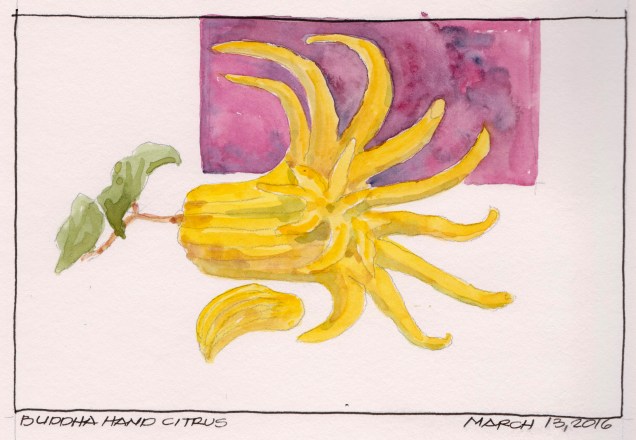
Buddha Hand

A continuation of fruit and vegetables series completed with a quick proportion pencil sketch and then watercolor with no ink. Buddha’s Hand citron, AKA bushukan (Japanese) or fingered citron, produces deep lemon yellow fruits that vary in shape and size. The fruit splits at the opposite end of the tree’s stem forming segments that have a wild finger-like appearance, hence its given name. Its flesh is void of juice, pulp and seeds, rendering it inedible. The culinary virtues lie within its oily rind which is powerfully fragrant and aromatic and utilized for its zesting properties. Buddha’s Hand citron flavor is described as a unique blend of bitter and sweet, similar to kumquats and tangerines, with lavender notes and a bright lemon highlight. Daniel Smith and Holbein watercolors in a Stillman and Birn sketchbook.

2016-03-13 Buddha Hand

Tomatillo

A continuation of fruit and vegetables series completed with a quick proportion pencil sketch and then watercolor with no ink. Tomatillos are a relative of the tomato and member of the nightshade (Solanaceae) family. Tomatillos provide that tart flavor in a host of Mexican green sauces. In Mexico the fruit is called tomates verdes, tomates de cascara as well as fresadillas. The fruits average about 1 -2″ wide and have a papery outer skin. The tomatillo is actually used when it is still green. Tomatillos have a very tart flavor, not at all like a tomato. Daniel Smith and Holbein watercolors in a Stillman and Birn sketchbook.

2016-03-11 Tomatillo

Guava

A continuation of fruit and vegetables series completed with a quick proportion pencil sketch and then watercolor with no ink. Guavas are common tropical fruits cultivated and enjoyed in many tropical and subtropical regions. The common guava is a small tree in the Myrtle, native to Mexico, Central America and northern South America. Guava fruits, usually 4 to 12 centimetres (1.6 to 4.7 in) long, are round or oval depending on the species.They have a pronounced and typical fragrance, similar to lemon rind but less sharp. The outer skin may be rough, often with a bitter taste, or soft and sweet. Varying between species, the skin can be any thickness, is usually green before maturity, but becomes yellow, maroon, or green when ripe. The pulp inside may be sweet or sour and off-white (“white” guavas) to deep pink (“red” guavas). The seeds in the central pulp vary in number and hardness, depending on species. Daniel Smith and Holbein watercolors in a Stillman and Birn sketchbook.

2016-03-10 Guava

Spring Lake Golf Club 3

Another drawing completed for the architectural presentation at Spring Lake Golf Club on the Jersey Shore in Spring Lake Heights, New Jersey. This is an exterior elevation of the proposed renovations and additions to the clubhouse as seen from the parking area. This will be the main entrance for the members for golf and dining. Holbein and Daniel Smith watercolors on watercolor board, 27″ x 7″.

2016-03-09 Parking Elevation

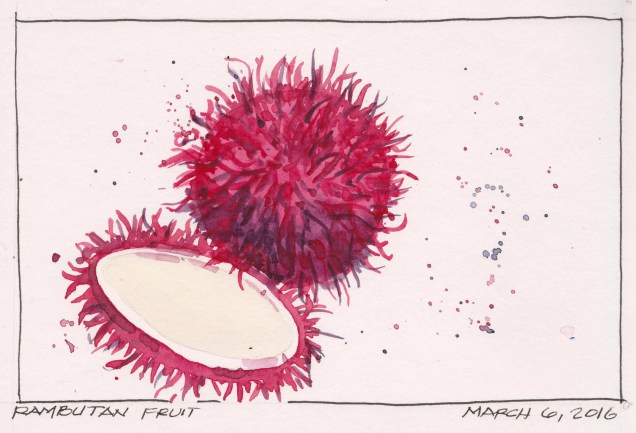
Rambutan Fruit

A continuation of fruit and vegetables series completed with a quick proportion pencil sketch and then watercolor with no ink. Rambutan evergreen tree is native to tropical Southeast Asia and commonly grown throughout Indonesia, Malaysia, Thailand and the Philippines. The fruit is a round to oval single-seeded berry, 3–6 cm  long and 3–4 cm broad, borne in a loose pendant cluster of 10–20 together. The leathery skin is reddish (rarely orange or yellow), and covered with fleshy pliable spines, hence the name, which means ‘hairs’. The fruit flesh, which is actually the aril, is translucent, whitish or very pale pink, with a sweet, mildly acidic flavor very reminiscent of grapes. Daniel Smith and Holbein watercolors in a Stillman and Birn sketchbook.
2016-03-06 Rambutan Fruit