Dragon Fruit

A continuation of fruit and vegetables series completed with a quick proportion pencil sketch and then watercolor with no ink. Who knew there was a plant with a flower like an explosion of flame, which produces a beautiful but short-lived fruit with the appearance of a brilliant pink rosebud? This is the pitya or dragon fruit, indigenous to Central America but is also grown and exported from several Southeast Asian countries, such as Thailand and Vietnam. Obtained from several cactus species, its succulent stem provides the uniquely delicious fruit with moisture in the arid climates where it grows. Some dragon fruits have red or yellow skin (which looks a little like a soft pineapple with spikes) and white or red flesh, but always the beginnings of overlaid leaves, similar to an artichoke, and an abundance of small, black, edible seeds. The flavor is mildly sweet, like a blend of kiwi and pear, and it has a crunchy texture. Daniel Smith and Holbein watercolors in a Stillman and Birn sketchbook.
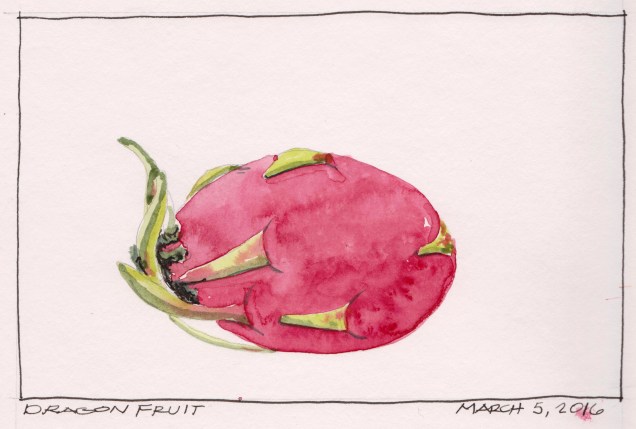
2016-03-05 Dragon Fruit

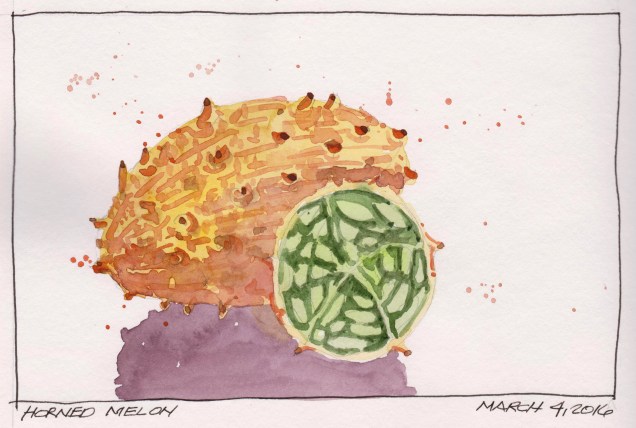
Horned Melon

A continuation of fruit and vegetables series completed with a quick proportion pencil sketch and then watercolor with no ink. Cucumis metulfierus, horned melon or kiwano, also African horned cucumber or melon, jelly melon, hedged gourd, melano, in the southeastern United States, blowfish fruit, is an annual vine in the cucumber and melon family. Its fruit has horn-like spines, hence the name “horned melon”. Ripe fruit has yellow-orange skin and lime green, jelly-like flesh with a tart taste, and texture similar to a cucumber. The one and only time I tried a horned melon I was totally surprised by the bright green interior and the taste was not to my liking.  Daniel Smith and Holbein watercolors in a Stillman and Birn sketchbook.

2016-03-04 Horned Melon

Cactus Fruit

A new series of fruit and vegetables completed with a quick proportion pencil sketch and then watercolor with no ink. Cactus Fruit from the Indian Fig Opuntia and is commonly referred in most culinary uses as a Prickly Pear”. Prickly pears typically grow with flat, rounded cladodes (also called platyclades) armed with two kinds of spines; large, smooth, fixed spines and small, hairlike prickles called glochids, that easily penetrate skin and detach from the plant. Many types of prickly pears grow into dense, tangled structures and the fruit is delicious once you get past the thorns. Daniel Smith and Holbein watercolors in a Stillman and Birn sketchbook.
2016-03-03 Cactus Fruit


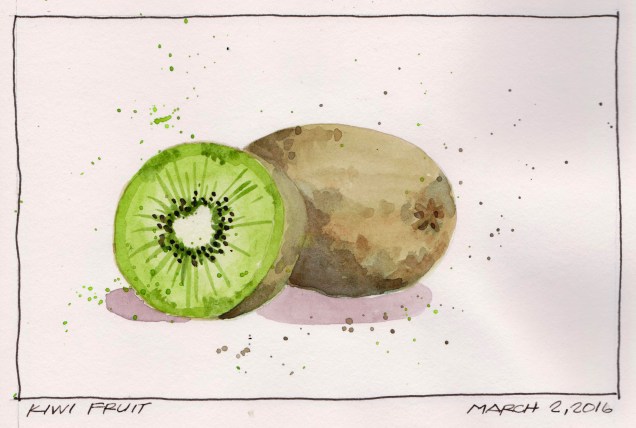
Kiwi Fruit

A continuation of fruit and vegetables series completed with a quick proportion pencil sketch and then watercolor with no ink. The kiwifruit, native to northern China, was first brought to and cultivated in New Zealand at the turn of the 20th century and was then known as the Chinese Gooseberry. When the time came to export the fruit, to avoid the high duties charged on berries, the name was changed to the kiwifruit, or kiwi because of the fruit’s shared characteristics with New Zealand’s national symbol, the kiwi bird, which is also small, brown and fuzzy. Daniel Smith and Holbein watercolors in a Stillman and Birn sketchbook.

2016-03-02 Kiwi Fruit

Strawberries

A new series of fruit and vegetables series completed with a quick proportion pencil sketch and then watercolor with no ink.

The garden strawberry is a widely grown hybrid species of the genus Fragaria (collectively known as the strawberries). It is cultivated worldwide for its fruit. The fruit (which is not a botanical berry, but an aggregate accessory fruit) is widely appreciated for its characteristic aroma, bright red color, juicy texture, and sweetness. It is consumed in large quantities, either fresh or in  prepared foods.The garden strawberry was first bred in Brittany, France, in the 1750s via a cross of fruit from eastern North America and Chile. Daniel Smith and Holbein watercolors in a Stillman and Birn sketchbook.

2016-03-01 Strawberries

Orient Point Lighthouse

A wonderful ferry trip across Long Island Sound from New London, Connecticut to Orient Point, New York. This is a view of the Orient Point Lighthouse as you approach the harbor at the far Eastern end of Long Island.  The lighthouse is located on a reef just below the water. The deep and narrow gap between Orient Point and Plum Island is called Plum Gut, and at ebb tide, the waters of Long Island Sound rush through at currents exceeding 5 knots, creating a churning mix of white-capped waves and dangerous riptides that is a challenge for even the most experienced mariners. Oyster Pond Reef, a dangerous obstacle lying just beneath the surface of the water extends from Orient Point one third of the way across Plum Gut, making the passage even more treacherous. Pilot Falcon fountain pen with Noodler’s black ink and Holbein watercolors in a Stillman and Birn sketchbook.
2016-02-29 Orient Point Lighthouse

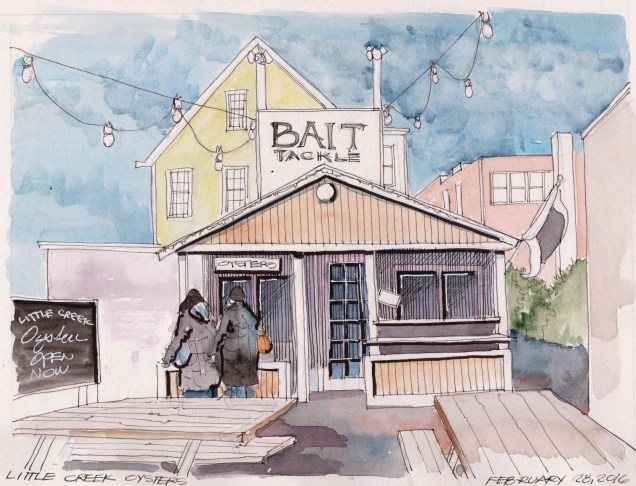
Bait and Tackle

Another stop as we were walking around Greenport, NY. A tiny structure that was a Bait and Tackle shop that is now Little Creek Oyster Bar. This is located on the harbor in Greenport. It was a beautiful, cold, sunny day after a week of strong winds. Pilot Falcon fountain pen with Noodler’s black ink and Holbein watercolors in a Stillman and Birn sketchbook.

2016-02-28 Bait Tackle

Celebration of George

Today we reunited with friends to attend a Celebration of Life for one of our dear professors of architecture at Oklahoma State University. Professor George Baumiller was 97 years old and an amazing person, teacher and friend. The celebration was at his home and studio in Greenport, Long Island, New York. The home was filled with wonderful family, friends, students and neighbors that were all touched by George. This is a sketch of the front of his home with the trellis on the front of the house. He loved the roses that grew on this trellis and paper flowers were hung on the vines as a remembrance. Pilot Falcon fountain pen with Noodler’s black ink and Holbein watercolors in a Stillman and Birn Beta sketchbook.

2016-02-27 Georges House

Hermit Crab

The hermit crab is a type of crab that does no have a very hard shell. Not actually a true crab, it uses other animals’ old shells for protection; they especially like whelk shells. As a hermit crab grows in size, it must continue to find larger shells. There are about 500 species of hermit crabs found throughout the world. Most hermit crabs live on the ocean floor, but many can live on land. The sketch is  direct to watercolor without ink. Holbein and Daniel Smith watercolors in a Stillman and Birn sketchbook.

2016-02-25 Hermit Crab

Sally Lightfoot Crab

The Sally Lightfoot crab, sometimes called the red rock crab, is a common sight on rocky beaches on the Atlantic and Pacific coastlines of the Americas, from Florida down to Brazil.  Adults, which have carapace widths of around 5-8 centimeters, are generally bright red, brown, or orange with various patterns, while young Sally Lightfoot crabs are darker-colored. Sally Lightfoot crabs spend most of their time hiding away in rock crevices, but when they come out to feed they move with the remarkable agility and speed that give them their common name. While they feed, powerful waves often crash over them, but they are able to withstand these by flattening themselves against rocks and holding on tightly. Although these crabs mainly eat red and green algae, they will eat practically anything they can get, including mussels, barnacles, other crabs, young sea turtles, dead fish. The sketch is  direct to watercolor without ink. Holbein and Daniel Smith watercolors in a Stillman and Birn sketchbook.
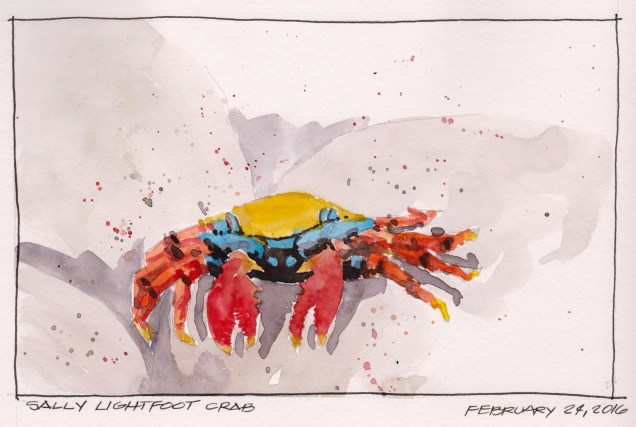
2016-02-24 Sally Lightfoot Crab