“Never waste any amount of time doing anything important when there is a sunset outside that you should be sitting under!” – C. JoyBell C.

The close of another wonderful summer month. Amazing sunset over Plymouth Harbor, perfectly calm with true reflections on the water like glass. The colors blended perfectly from deep orange on the horizon to a deep Cobalt in the upper sky. Difficult to achieve a graded wash in this sketchbook. Holbein and Mission Watercolors, Black Pitt pens and a white gel pen in a Stillman and Birn Sketchbook.

2015-07-31 Plymouth Harbor Sunset

Black Eyed Susans

The Black Eyed Susans are at their peak in our yard. They are such bright and cheerful flowers and we look forward to them every year. Black Eyed Susans (Rudbeckia hirta) are native to North America and one of the most popular wildflowers grown. They tend to blanket open fields, often surprising the passer-by with their golden-yellow beauty. Members of the sunflower family, the “black eye” is named for the dark brown-purple centers of its daisy-like flower heads. The plants can grow to over 3 feet tall, with leaves of 6 inches, stalks over 8 inches long and flower diameter of 2 to 3 inches. Holbein Watercolors in a Stillman and Birn Alpha series sketchbook.

2015-07-29 Black Eyed Susans

Cone Flowers

A quick watercolor of some of the Cone Flowers in our garden. They are so bright and cheery along with the Black Eyed Susan. The Coneflower is a native North American perennial sporting daisy like flowers with raised centers.  Widely renowned as a medicinal plant, coneflowers are a long-flowering perennial for borders, wildflower meadows, and prairie gardens. Blooming midsummer to fall, the plants are relatively drought-tolerant and rarely bothered by pests. The flowers are a magnet for butterflies, and the seeds in the dried flower heads attract songbirds. Holbein watercolors in a Stillman and Birn Alpha Sketchbook.

2015-07-21 Cone Flowers

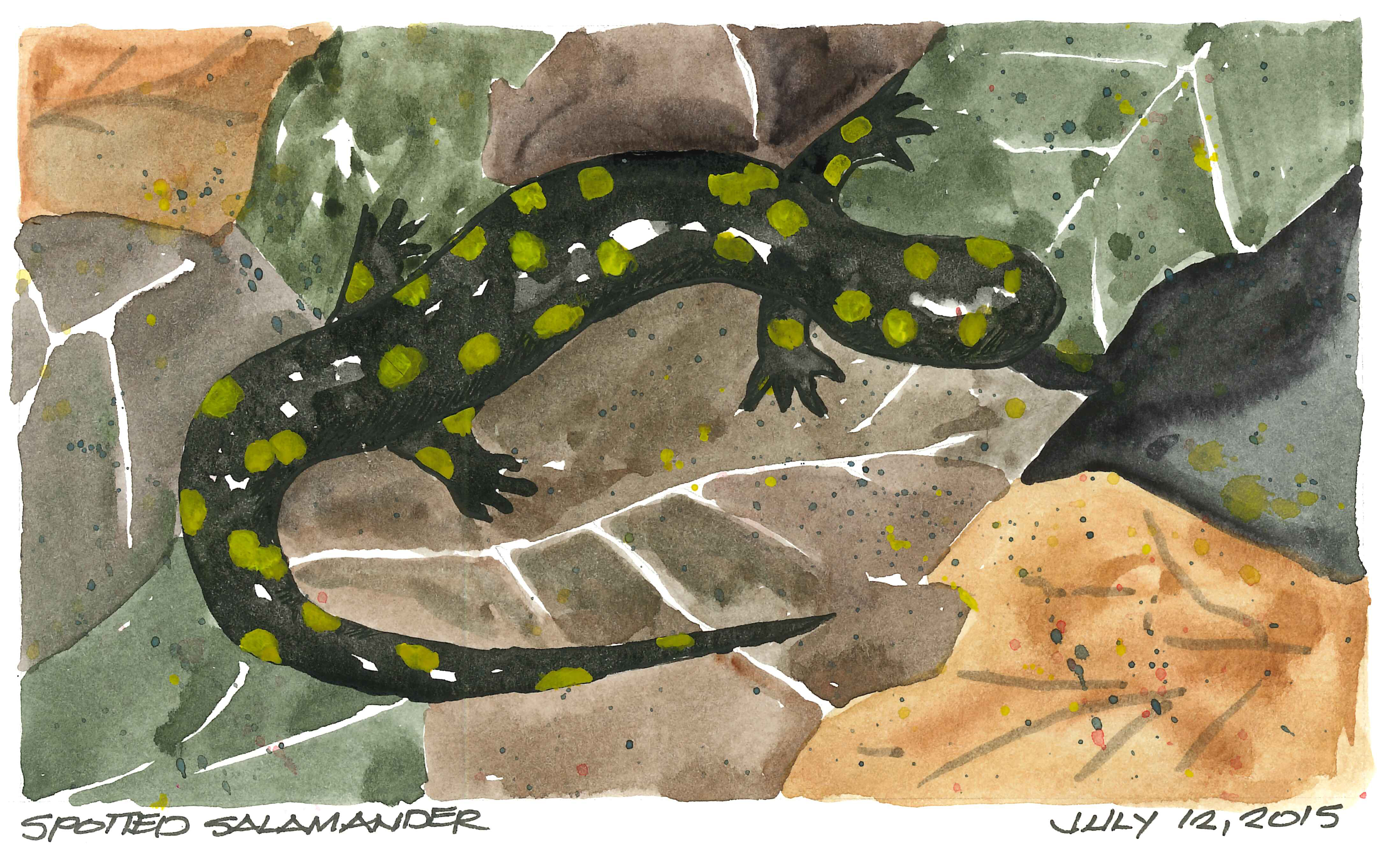
Spotted Salamander

While cleaning and preparing the fountain in our yard for this season, I noticed a Spotted Salamander. I have never seen one of these before and it was about 6″ long. They are stout, like most mole salamanders, and have wide snouts. The spotted salamander’s main color is black with two uneven rows of yellowish-orange spots run from the top of the head (near the eyes) to the tip of the tail. The spotted salamander usually makes its home in hardwood forest areas with vernal pools, which are necessary for breeding. Spotted salamanders are fossorial, meaning they spend most of their time underground. Holbein watercolors in a 5″ x 9″ Moleskine Watercolor Sketchbook.

2015-07-12 Spotted Salamander