Another view of the harbor in Milford, Connecticut from last week. A couple of sailboats on jack stands under going restoration at the Milford Boatworks. Faber Castell Pitt Art pens with limited Holbein watercolors in a Stillman and Birn sketchbook.
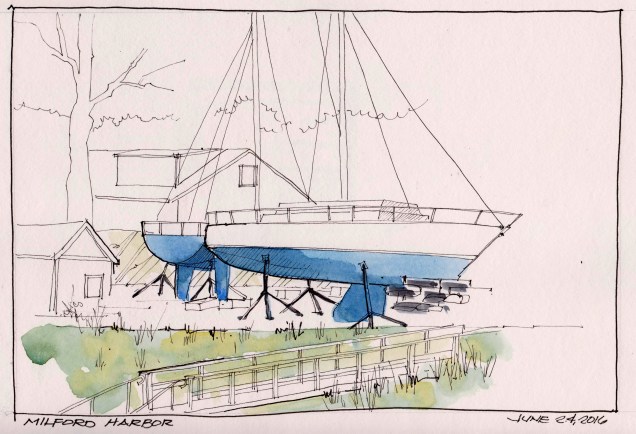
Another view of the harbor in Milford, Connecticut from last week. A couple of sailboats on jack stands under going restoration at the Milford Boatworks. Faber Castell Pitt Art pens with limited Holbein watercolors in a Stillman and Birn sketchbook.
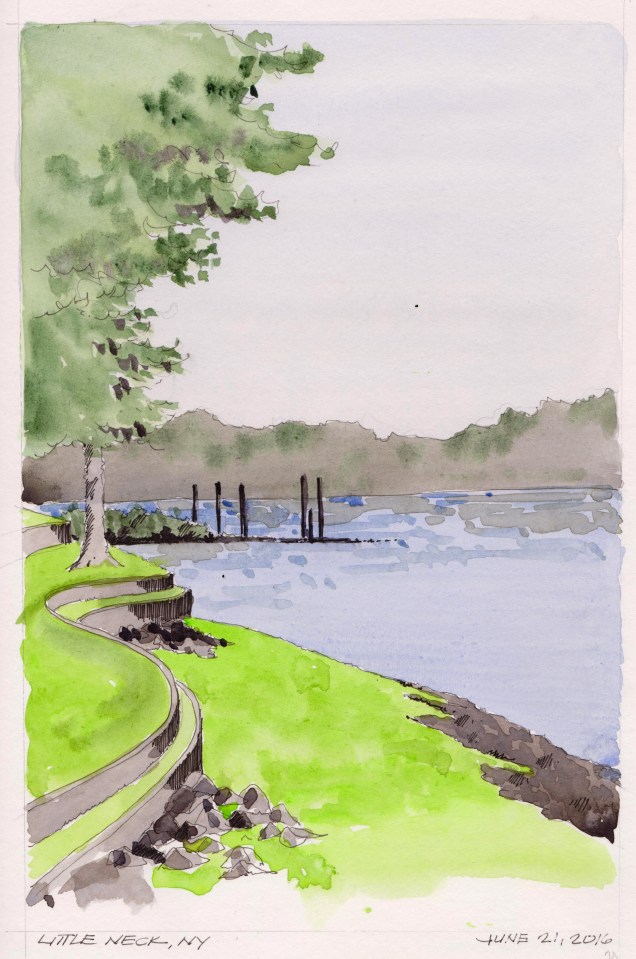
A beautiful part of the coastline in Little Neck, New York. This is actually in the borough of Queens in New York City. A peaceful oasis within the city. This caught my eye with the undulating seawall and the contrast between the bright green grass and the very dark rocks. Lamy Safari with Noodler’s black ink and Holbein watercolors in a Stillman and Birn sketchbook.
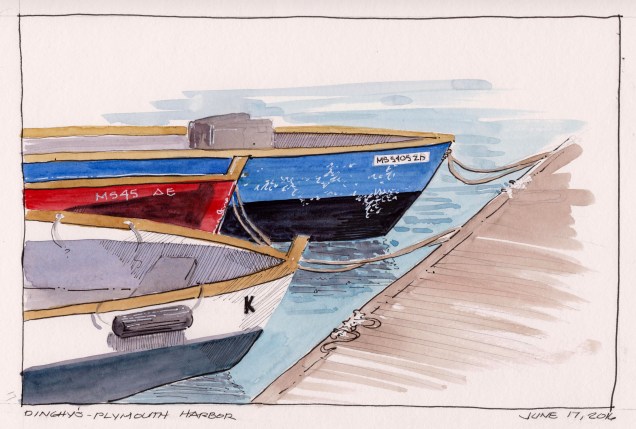
After dinner in Plymouth, Massachusetts, we went for a walk along the waterfront. There were many dinghies tied up along this one dock. The shapes and colors were intriguing. Lamy fountain pen with Noodler’s black ink and Holbein watercolors in a Stillman and Birn Beta sketchbook.
Simple line drawing of a stone jetty at our favorite local beach – Little Harbor in Wareham, Massachusetts. This sketch is from a photograph and was completed with a Lamy Safari fountain pen with Noodler’s black ink in a Stillman and Birn sketchbook.

A continuation of the Jellyfish and Ocean theme with another view of the Crown Jellyfish. The sketch is direct to watercolor without ink. Holbein and Daniel Smith watercolors in a Stillman and Birn sketchbook.
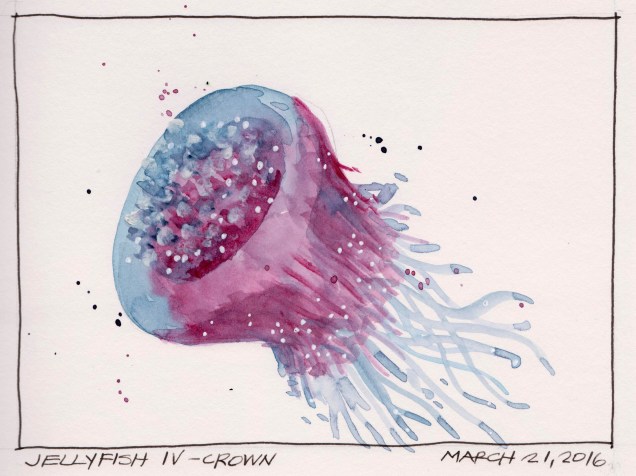
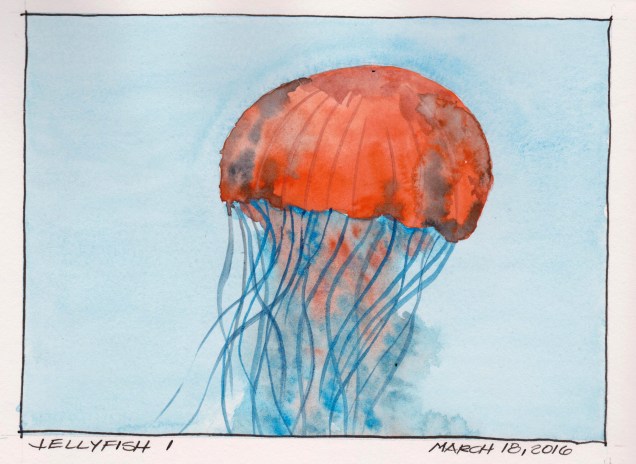
A continuation of the Jellyfish and Ocean theme. The sketch is direct to watercolor without ink. Holbein and Daniel Smith watercolors in a Stillman and Birn sketchbook.
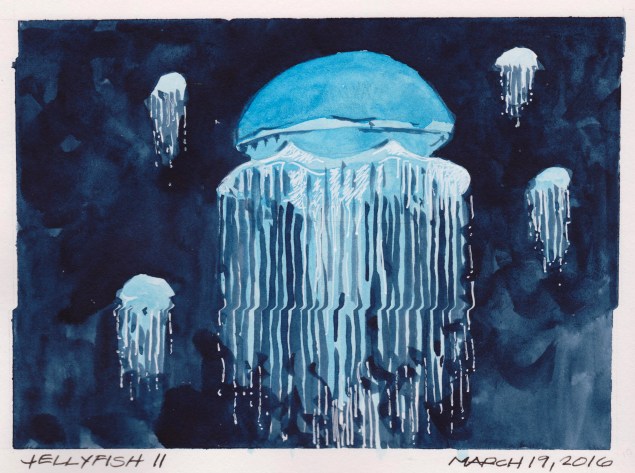
First of a week series of Jellyfish to get back to the ocean theme. They are typified as free-swimming marine animals consisting of a gelatinous umbrella-shaped bell and trailing tentacles. The bell can pulsate for locomotion, while stinging tentacles can be used to capture prey. Jellyfish are found in every ocean, from the surface to the deep sea. Large, often colorful, jellyfish are common in coastal zones worldwide. Jellyfish have roamed the seas for at least 500 million years, and possibly 700 million years or more, making them the oldest multi-organ animal. The sketch is direct to watercolor without ink. Holbein and Daniel Smith watercolors in a Stillman and Birn sketchbook.
The hermit crab is a type of crab that does no have a very hard shell. Not actually a true crab, it uses other animals’ old shells for protection; they especially like whelk shells. As a hermit crab grows in size, it must continue to find larger shells. There are about 500 species of hermit crabs found throughout the world. Most hermit crabs live on the ocean floor, but many can live on land. The sketch is direct to watercolor without ink. Holbein and Daniel Smith watercolors in a Stillman and Birn sketchbook.

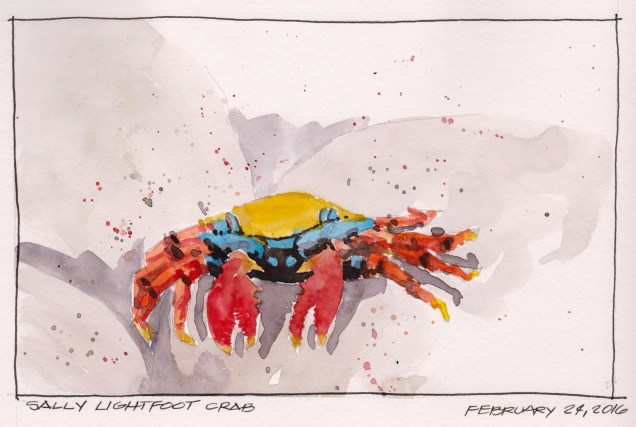
The Sally Lightfoot crab, sometimes called the red rock crab, is a common sight on rocky beaches on the Atlantic and Pacific coastlines of the Americas, from Florida down to Brazil. Adults, which have carapace widths of around 5-8 centimeters, are generally bright red, brown, or orange with various patterns, while young Sally Lightfoot crabs are darker-colored. Sally Lightfoot crabs spend most of their time hiding away in rock crevices, but when they come out to feed they move with the remarkable agility and speed that give them their common name. While they feed, powerful waves often crash over them, but they are able to withstand these by flattening themselves against rocks and holding on tightly. Although these crabs mainly eat red and green algae, they will eat practically anything they can get, including mussels, barnacles, other crabs, young sea turtles, dead fish. The sketch is direct to watercolor without ink. Holbein and Daniel Smith watercolors in a Stillman and Birn sketchbook.
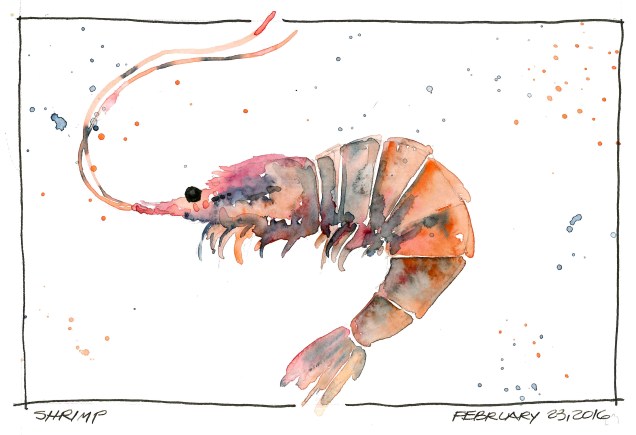
Shrimp are swimming crustaceans with long narrow muscular abdomens and long antennae. Unlike crabs and lobsters, shrimp have well developed pleopods (swimmerets) and slender walking legs; they are more adapted for swimming than walking. Members of the Natantia (shrimp in the broader sense) were adapted for swimming while the Reptantia (crabs, lobsters, etc.) were adapted for crawling or walking. Some other groups also have common names that include the word “shrimp”; any small swimming crustacean resembling a shrimp tends to be called one. The sketch is direct to watercolor without ink. Holbein and Daniel Smith watercolors in a Stillman and Birn sketchbook.
 A SKETCHBOOK ODYSSEY