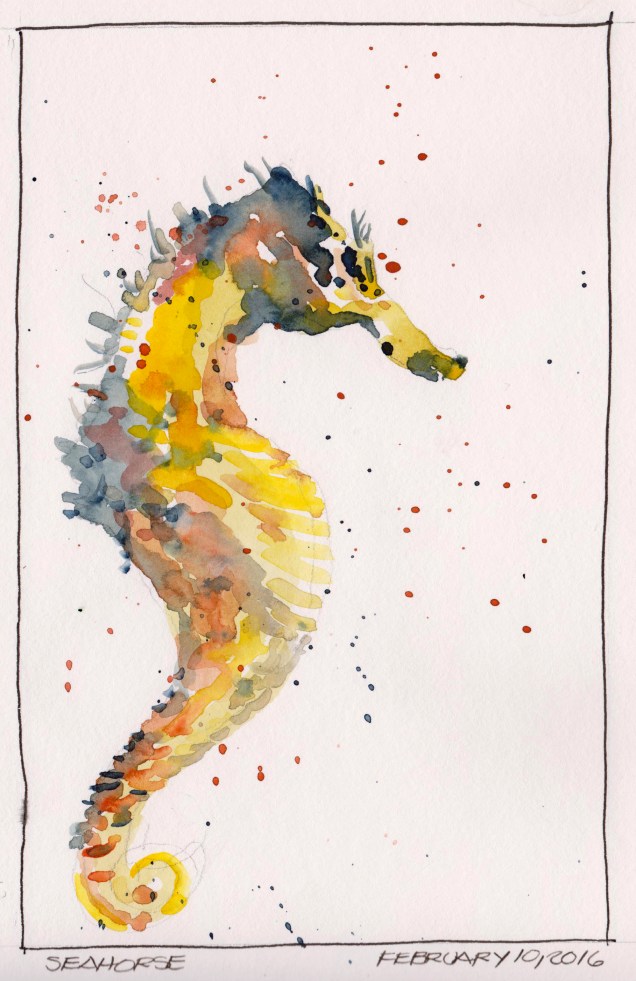
Seahorse

To continue the ocean theme I seem to be on with a different, looser style for me. This painting was inspired by some work I saw from Welsh Artist Alison Fennel. Seahorses range in size from 1.5 to 35.5 cm. They are named for their equine appearance with bent necks and long snouted heads followed by their distinctive trunk and tail.Although they are  bony fish, they do not have scales, but rather thin skin stretched over a series of bony plates, which are arranged in rings throughout their bodies. Seahorses swim upright and use their tail to anchor .The sketch is a quick pencil sketch for proportions and then direct to watercolor without ink.  Pilot Falcon fountain pen with Noodler’s Black ink and Holbein watercolors in a Stillman and Birn sketchbook.
2016-02-10 Seahorse

Scallop Shells

To continue the ocean theme I seem to be on – small sketch of Scallop Shells from a photo on the internet. Scallops are a cosmopolitan family of bivalves, found in all of the world’s oceans, though never in freshwater. They are one of very few groups of bivalves to be primarily “free-living”; many species are capable of rapidly swimming short distances and even of migrating some distance across the ocean floor. The majority of species, however, live recumbent on sandy substrates, and when they sense the presence of a predator such as a starfish, they are able to escape by swimming swiftly but erratically through the water using a form of jet propulsion created by repeatedly clapping of their shells together. Pilot Falcon fountain pen with Noodler’s Black ink and Holbein watercolors in a Stillman and Birn sketchbook.

2016-02-09 Scallops

Ribbed Mussels

A small sketch of Ribbed Mussels from a photo on the internet. Ribbed mussels are similar to blue mussels in shape and size but differ in appearance, color, and habitat. The shell of a ribbed mussel is shaped like a long rounded triangle with corrugated ribs along the length. Ribbed mussels are usually found partially buried in the sediment, unlike the blue mussel that attaches to a piling or dock. When buried in the sediment, two slit-like siphons with frilled edges extend from the body to the muddy surface. Pilot Falcon fountain pen with Noodler’s Black ink and Holbein watercolors in a Stillman and Birn sketchbook.
2016-02-08 Ribbed Mussels

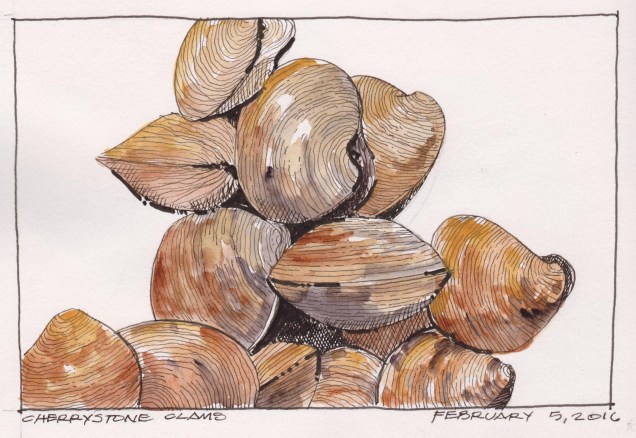
Cherrystone Clams

A small sketch of Cherrystone Clams from a photo on the internet. The hard clam, also known as a quahog (or quahaug), round clam, or hard-shell clam, is an edible marine bivalve mollusk that is native to the eastern shores of North America and  Central America, from Prince Edward Island to the Yucatan Peninsula. Pilot Falcon fountain pen with Noodler’s Black ink and Holbein watercolors in a Stillman and Birn sketchbook.
2016-02-05 Cherrystones

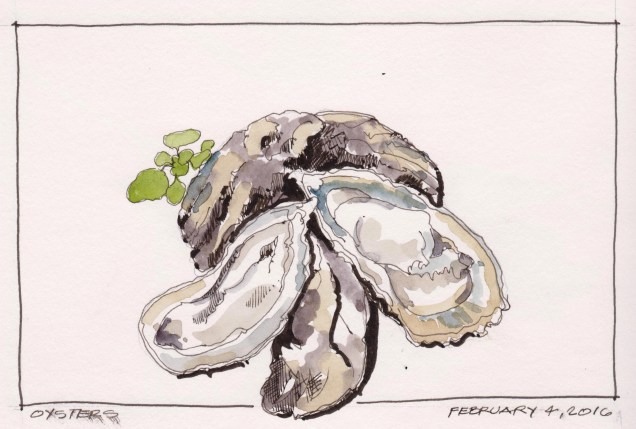
Oysters

A small sketch of local oysters from a photo on the internet. Oysters are amazing in that they are the most economical farmed seafood. They are filter feeders and can filter an amazing amount of water and clean it from impurities. Pilot Falcon fountain pen with Noodler’s Black ink and Holbein watercolors in a Stillman and Birn sketchbook.
2016-02-04 Oysters

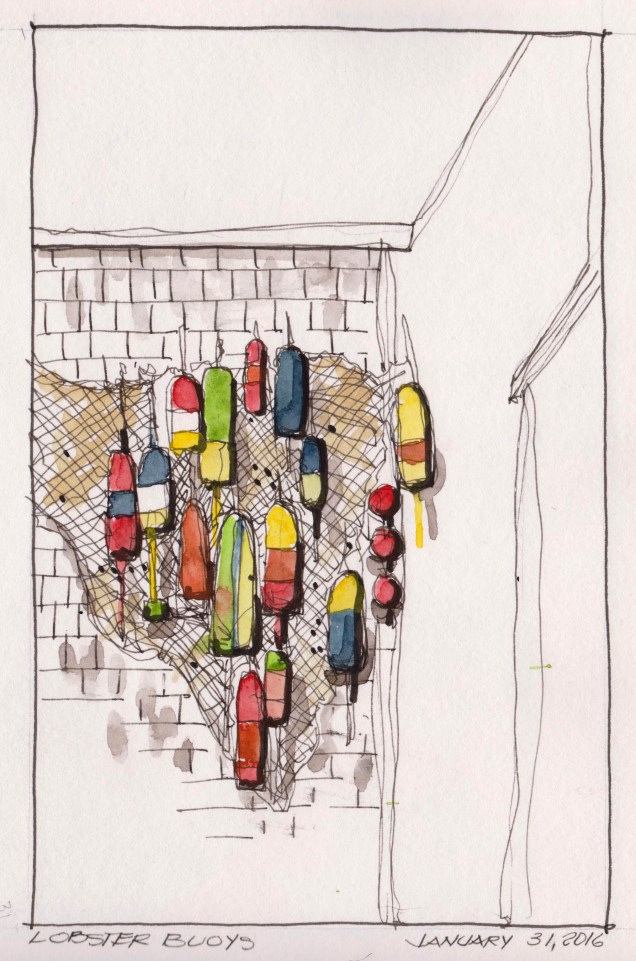
Lobster Buoys

This week is a series of quick sketches that are related to the sea. I have to start doing quicker sketches during the week with so little time to draw and scan. A small sketch of colorful Lobster Buoys on the side of a New England shack. Pilot Falcon fountain pen with Noodler’s Black ink and Holbein watercolors in a Stillman and Birn sketchbook.
2016-01-31 Lobster Buoys

Kite Boarder

A quick sketch of a Kite Boarder enjoying a winter day at Harding Beach in Chatham, Massachusetts. The air temperature was about 30 degrees and the water temperature about 40 degrees. It is always enjoyable to watch the Kite Boarders and the Wind Surfers. Minimal line work with a Pilot Falcon fountain pen with Noodler’s Black ink and  Holbein watercolors in a Stillman and Birn Beta sketchbook.

2016-01-20 Kiter