Purple Beets

The beetroot is the taproot portion of the beet plant, usually known in North America as the beet, also table beet, garden beet, red beet or golden beet. It is several of the cultivated varieties grown for their edible taproots and their leaves (called beet greens). Other than as a food, beets have use as a food coloring and as a medicinal plant. Pilot Falcon fountain pen with Noodler’s black ink and Holbein watercolors in a Stillman and Birn sketchbook.

2016-04-05 Purple Beets


Carrots

The carrot is a root vegetable, usually orange in colour, though purple, black, red, white, and yellow varieties exist.It has a crisp texture when fresh. The most commonly eaten part of a carrot is a taproot, although the greens are sometimes eaten as well. It is a domesticated form of the wild carrot, native to Europe and southwestern Asia. The domestic carrot has been selectively bred for its greatly enlarged and more palatable, less woody-textured edible taproot. Pilot Falcon fountain pen with Noodler’s Black Ink and Holbein watercolors in a Stillman and Birn sketchbook.

2016-04-04 Carrots

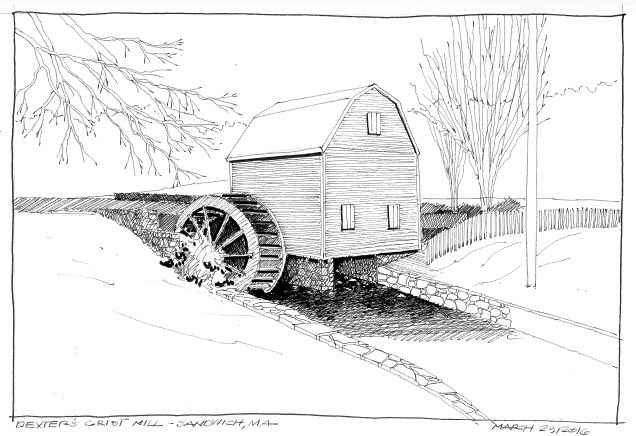
Dexter’s Grist Mill

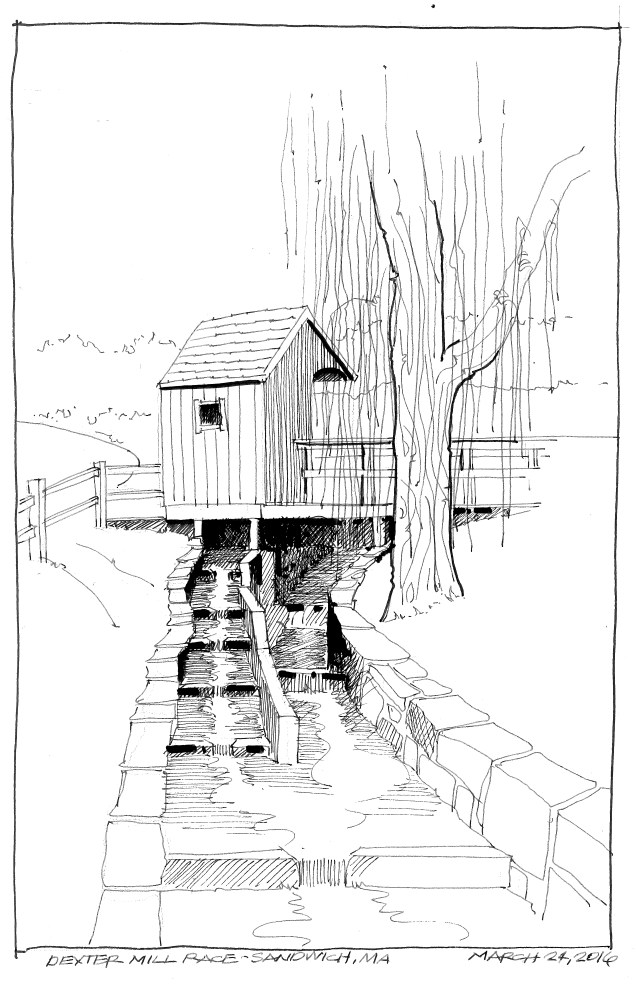
One of the oldest water mill sites existing in the United States today, Dexter’s Grist Mill, has Plymouth Colony Records dating back to 1640 in which Thomas Dexter was allocated 26 acres and 6 acres for his mill. In 1856 a new mill building replaced the old woolen mill and manufactured marble stone products. An iron turbine replaced the wooden waterwheel in Dexter’s Mill in 1856.The gristmill last operated in 1881 when Captain Laban Crocker was miller. In 1961 Dexter’s Mill was restored with authentic wooden parts and an undershot wooden waterwheel. The millstones were imported from France. The mill and mill grounds are well preserved. Dexter’s Mill sits on the dam, which creates a beautiful, large millpond. The meandering millrace is lined in cut stone. The foundation of the three-story building is laid in cut stone with an undershot wooden waterwheel on the east side. The mill building is sided with natural shake. Lamy fountain pen with Noodler’s Black Ink in a Stillman and Birn sketchbook.

2016-03-23 Dexters Grist Mill

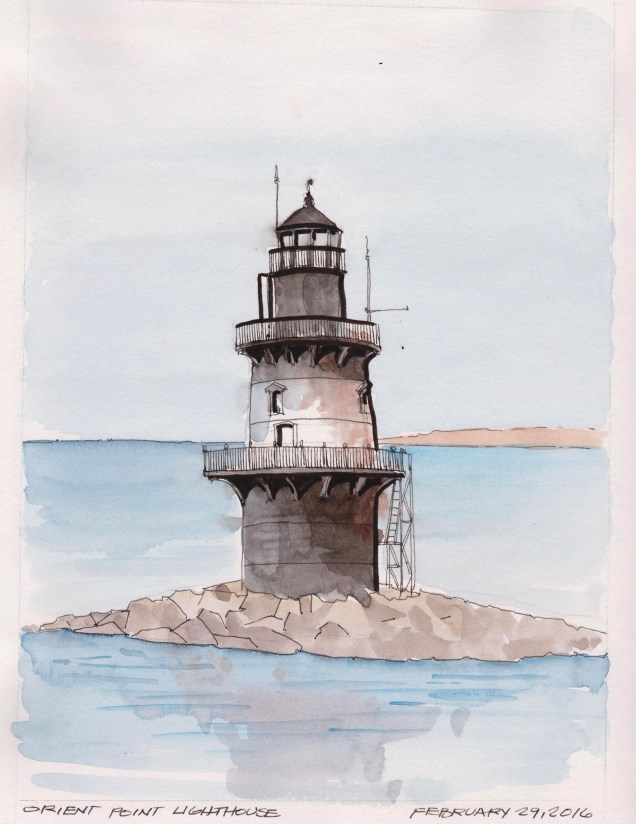
Orient Point Lighthouse

A wonderful ferry trip across Long Island Sound from New London, Connecticut to Orient Point, New York. This is a view of the Orient Point Lighthouse as you approach the harbor at the far Eastern end of Long Island.  The lighthouse is located on a reef just below the water. The deep and narrow gap between Orient Point and Plum Island is called Plum Gut, and at ebb tide, the waters of Long Island Sound rush through at currents exceeding 5 knots, creating a churning mix of white-capped waves and dangerous riptides that is a challenge for even the most experienced mariners. Oyster Pond Reef, a dangerous obstacle lying just beneath the surface of the water extends from Orient Point one third of the way across Plum Gut, making the passage even more treacherous. Pilot Falcon fountain pen with Noodler’s black ink and Holbein watercolors in a Stillman and Birn sketchbook.

2016-02-29 Orient Point Lighthouse

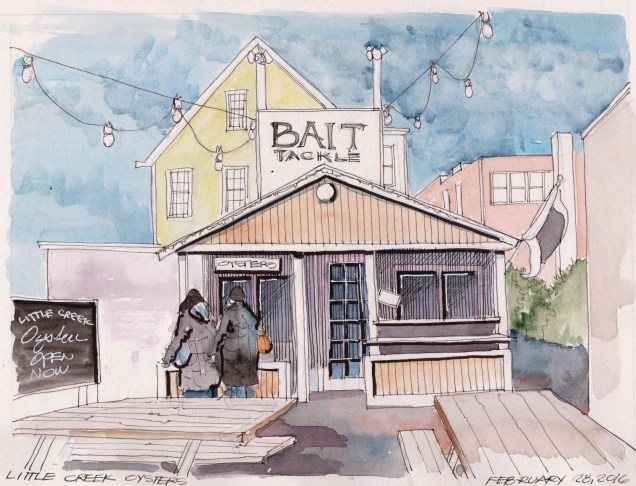
Bait and Tackle

Another stop as we were walking around Greenport, NY. A tiny structure that was a Bait and Tackle shop that is now Little Creek Oyster Bar. This is located on the harbor in Greenport. It was a beautiful, cold, sunny day after a week of strong winds. Pilot Falcon fountain pen with Noodler’s black ink and Holbein watercolors in a Stillman and Birn sketchbook.

2016-02-28 Bait Tackle

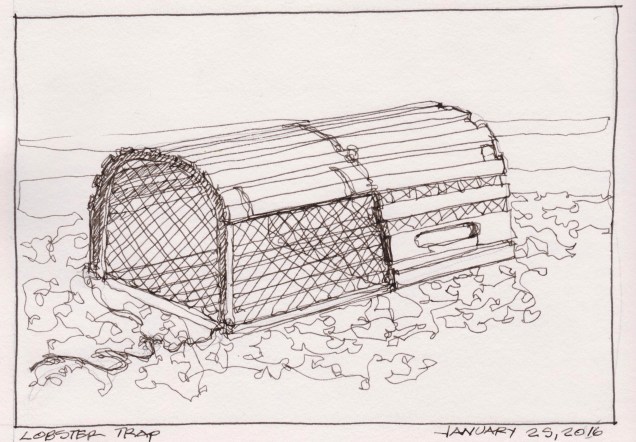
Lobster Trap

A quick sketch of a lobster trap that is very typical in New England. This is made of wood and the modern ones are metal. The method used for this sketch is a single line (almost), where you sketch without lifting the pen. A fun technique and looser than my usual style. Pilot Falcon fountain pen with Noodler’s black ink in a Stillman and Birn Sketchbook.

2016-01-25 Lobster Trap

Worcester Market

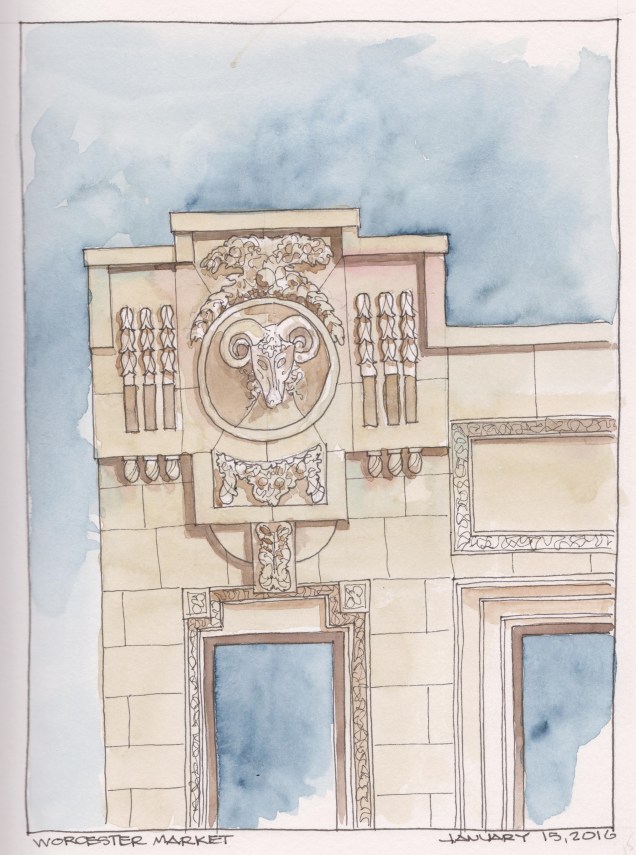
The Worcester Market Building is a historic commercial building at 831 Main Street in Worcester, Massachusetts. When it was built in 1914, it was believed to be the largest grocery supply building in the nation. It was built for Fayette Asyril Amidon, who had founded the Worcester Market in 1894 after establishing a similar enterprise in Providence, Rhode Island. The exterior of the building is terracotta that has been decorated with medallions on agricultural themes. The market was designed with modern ideas of efficiency. The main floor, covering 25,000 square feet, was devoted to retail space, and was designed to comfortably handle 4,500 customers. The basement and second floor were storage space, arranged so that supplies were located near their retail points on the main floor. These areas were connected to the main floor by elevators, eliminating the need for delivery vehicles to move in customer aisles. The building was listed on the National Register of Historic Places in 1090. Faber-Castell Pitt pens with Holbein and Daniel Smith watercolors in a Stillman and Birn sketchbook.
2016-01-15 Worcester Market

Brownstone feature

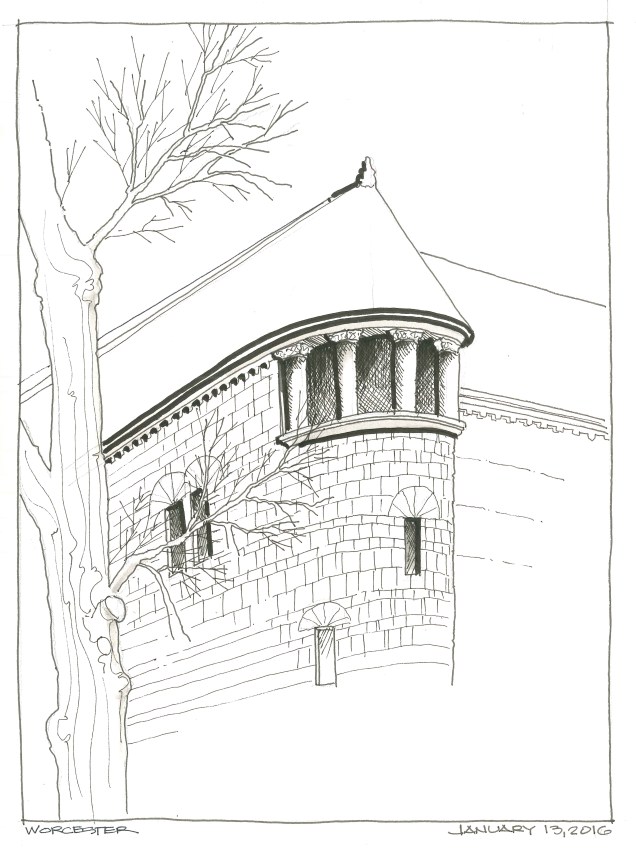
A quick pen and ink sketch of a brownstone in Worcester, Massachusetts. I was in town for a site meeting and this upper level covered porch was very interesting with the round carved columns and deep shadows. The sketch is from a photo that I took and the perspective is off in that it drops too fast off the page to the left. oh well, practice. Faber-Castell Pitt Art pens in black and some grays in a Stillman and Birn sketchbook.
2016-01-13 Worcester