Scribbled Angelfish

One more week of the looser, colorful ocean theme I have been on. The Scribbled Angelfish,  also known as Duboulay’s Angelfish, is a favorite among aquarists. The lips are a dull yellow while the face and body are predominately a dark blue-black. Separating the head from the body is a wide vertical band of yellow and white. A yellow stripe adorns the upper body and the caudal fin is also yellow. The Scribbled Angelfish derives its name from the many scrawls over the body and large dorsal and anal fins. Usually indistinguishable in color variations from male to female, the Scribbled Angelfish male may exhibit a small white patch on the gill cover. The sketch is a quick pencil sketch for proportions and then direct to watercolor without ink. Holbein and Daniel Smith watercolors in a Stillman and Birn sketchbook.
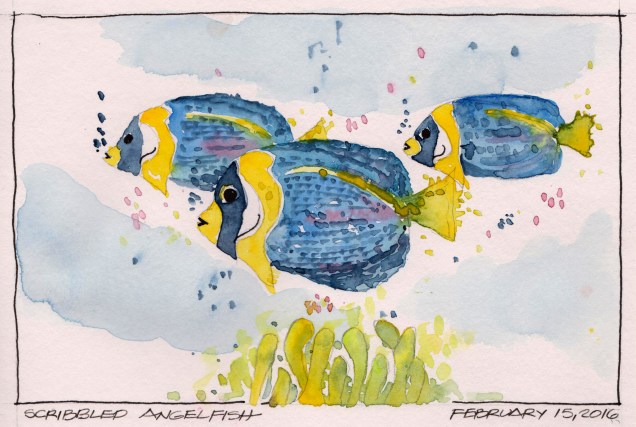
2016-02-15 Scribbled Angelfish

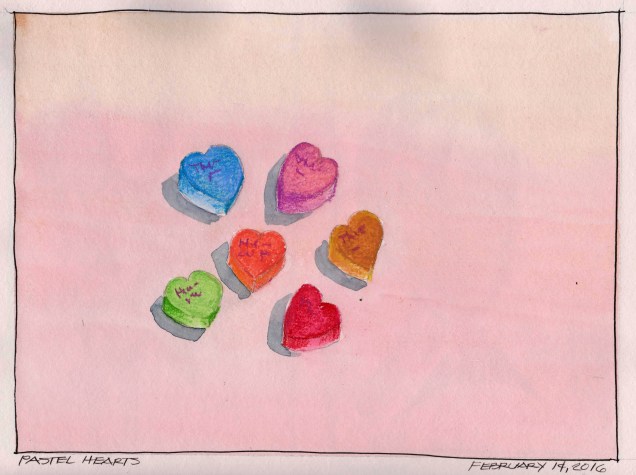
Pastel Hearts

Happy Valentines Day! a sketch using both watercolor for the background and pastels for the small candy hearts. I have only used pastels a couple of times and now I know why. I remember these candy hearts from when I was young with the sayings stamped into the surface. Holbein watercolor wash base with pastels that are a combination of Rembrandt sticks and Conte pencils in a Stillman and Birn Beta sketchbook.

2016-02-14 Pastel Hearts

Blue Mandarin

To continue the ocean theme I seem to be on with the looser style again. The mandarin fish has a body shape similar to a goby, though this is the only resemblance between the two. The vivid coloration sports a bright blue background, with swirly orange stripes and a blue-greenish face with bold blue stripes. The large pelvic fins are used for ‘walking’ on the seafloor and are often mistakenly seen as the pectoral fins. The real pectorals are located almost at the center and are nearly transparent, with a tinge of bright blue. The dorsal fin, which is exceptionally tall in males, has a striking orange-and blue design as well. The eyes are usually red with black pupils. Different varieties sport different markings and colors. The sketch is a quick pencil sketch for proportions and then direct to watercolor without ink.  Pilot Falcon fountain pen with Noodler’s Black ink and Holbein watercolors in a Stillman and Birn sketchbook.
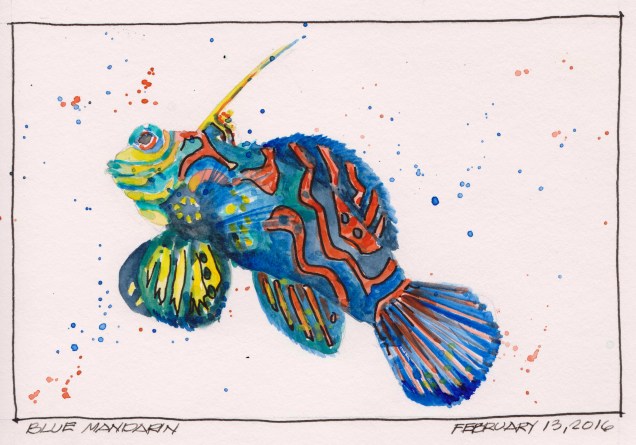
2016-02-13 Blue Mandarin

Tropical Fish

To continue the ocean theme I seem to be on with the looser style again. This sketch is from a photograph of a blue tropical fish. The sketch is a quick pencil sketch for proportions and then direct to watercolor without ink.  Pilot Falcon fountain pen with Noodler’s Black ink and Holbein watercolors in a Stillman and Birn sketchbook.
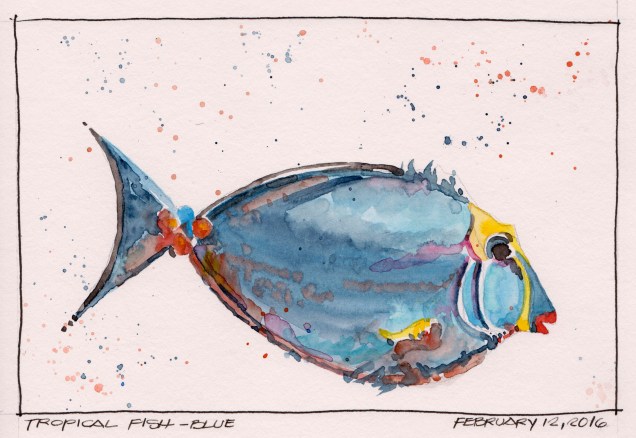
2016-02-12 Tropical Fish

Octopus

To continue the ocean theme I seem to be on with the looser style again. An octopus is a cephalopod mollusk. It has two eyes and four pairs of arms and, like other cephalopods, it is bilaterally symmetric. An octopus has a beak, with its mouth at the center point of the arms. An octopus has no internal or external skeleton allowing it to squeeze through tight places. Octopuses are among the most intelligent and behaviorally diverse of all invertebrates..The sketch is a quick pencil sketch for proportions and then direct to watercolor without ink.  Pilot Falcon fountain pen with Noodler’s Black ink and Holbein watercolors in a Stillman and Birn sketchbook.
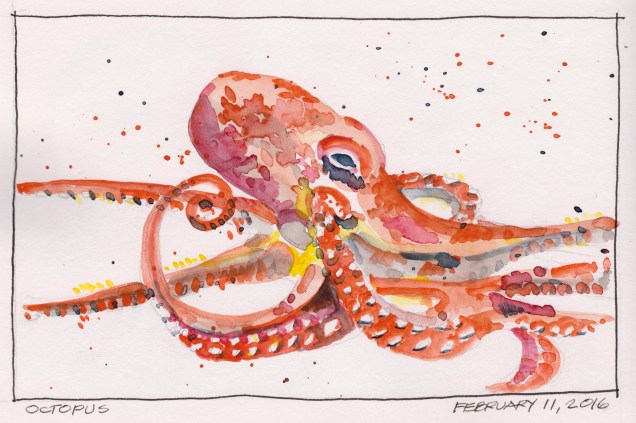
2016-02-11 Octopus

Seahorse

To continue the ocean theme I seem to be on with a different, looser style for me. This painting was inspired by some work I saw from Welsh Artist Alison Fennel. Seahorses range in size from 1.5 to 35.5 cm. They are named for their equine appearance with bent necks and long snouted heads followed by their distinctive trunk and tail.Although they are  bony fish, they do not have scales, but rather thin skin stretched over a series of bony plates, which are arranged in rings throughout their bodies. Seahorses swim upright and use their tail to anchor .The sketch is a quick pencil sketch for proportions and then direct to watercolor without ink.  Pilot Falcon fountain pen with Noodler’s Black ink and Holbein watercolors in a Stillman and Birn sketchbook.
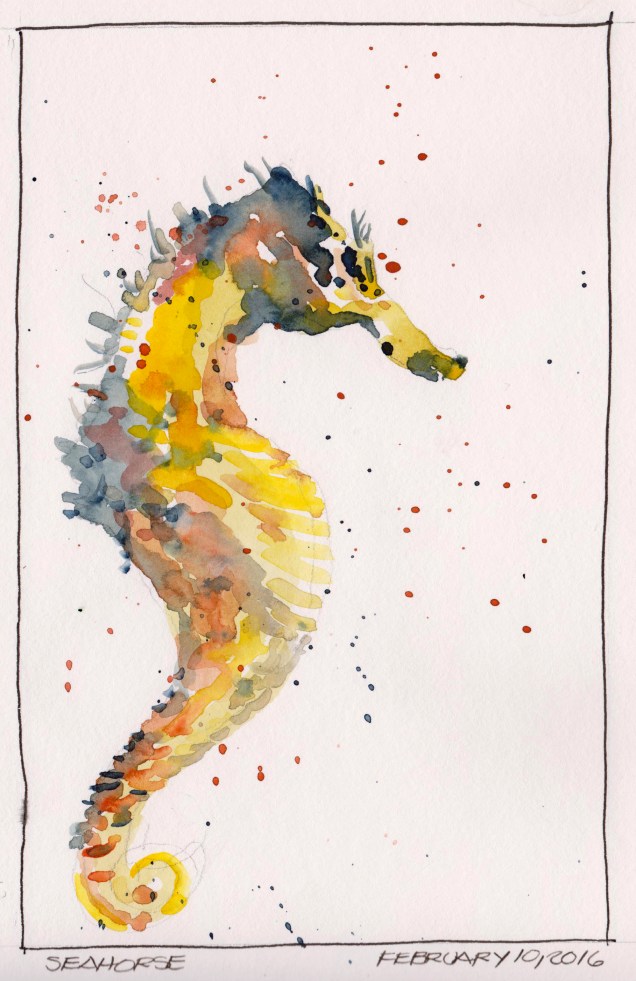
2016-02-10 Seahorse

Scallop Shells

To continue the ocean theme I seem to be on – small sketch of Scallop Shells from a photo on the internet. Scallops are a cosmopolitan family of bivalves, found in all of the world’s oceans, though never in freshwater. They are one of very few groups of bivalves to be primarily “free-living”; many species are capable of rapidly swimming short distances and even of migrating some distance across the ocean floor. The majority of species, however, live recumbent on sandy substrates, and when they sense the presence of a predator such as a starfish, they are able to escape by swimming swiftly but erratically through the water using a form of jet propulsion created by repeatedly clapping of their shells together. Pilot Falcon fountain pen with Noodler’s Black ink and Holbein watercolors in a Stillman and Birn sketchbook.

2016-02-09 Scallops

Ribbed Mussels

A small sketch of Ribbed Mussels from a photo on the internet. Ribbed mussels are similar to blue mussels in shape and size but differ in appearance, color, and habitat. The shell of a ribbed mussel is shaped like a long rounded triangle with corrugated ribs along the length. Ribbed mussels are usually found partially buried in the sediment, unlike the blue mussel that attaches to a piling or dock. When buried in the sediment, two slit-like siphons with frilled edges extend from the body to the muddy surface. Pilot Falcon fountain pen with Noodler’s Black ink and Holbein watercolors in a Stillman and Birn sketchbook.

2016-02-08 Ribbed Mussels

Line-up

This sketch was started at the entry to Falmouth Harbor in Falmouth, Massachusetts. My wife Lisa was going for a walk and I thought I would sketch the Seagulls that were all lined up on the tops of the pier pilings. After I drew about 10 lines a gentlemen came along and scared all of the seagulls into leaving. This left me with completing the sketch from memory and adding the color back at the house. Pilot Falcon fountain pen with Noodler’s black ink and Daniel Smith watercolors in a Stillman and Birn sketchbook.
2016-02-07 Line-up

Nauset Light

The present Nauset Lighthouse, which is listed on the National Register of Historic Places, is made of cast iron with a brick lining and stands 48 feet high. It was built in 1877, and was located in Chatham as a twin to the one that is there today. In 1923, the smaller wooden lighthouse in Eastham was retired, and the north tower in Chatham was dismantled, moved to Eastham, and reconstructed about 200 feet from the edge of the cliff near the relocated keeper’s house. In the 1940s, Nauset Light was painted red and white as a daytime indicator of the red and white beacon. Pilot Falcon fountain pen with Noodler’s black ink and Holbein watercolors in a Stillman and Birn sketchbook.

2016-02-06 Nauset Light