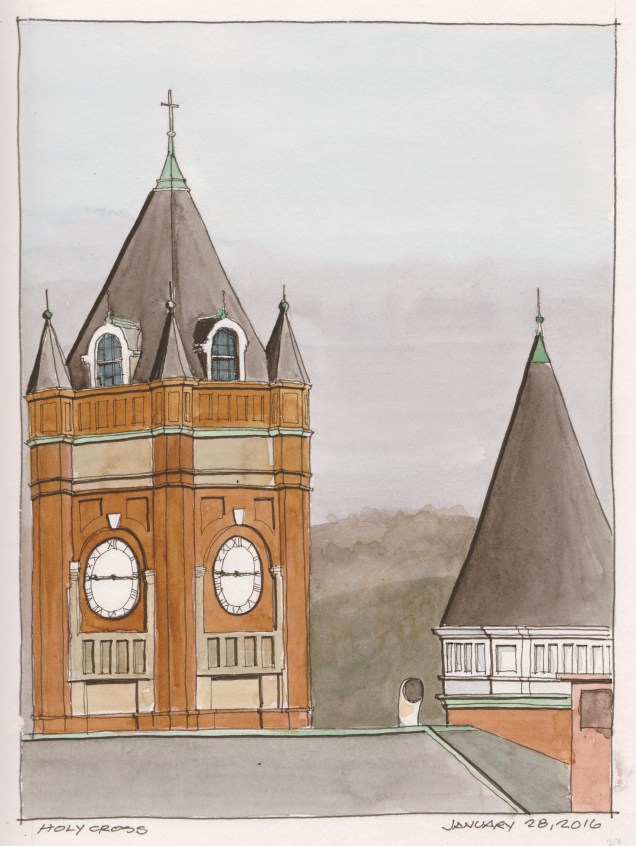
The College of the Holy Cross is a beautiful campus located on a hill in Worcester, Massachusetts. From the beginning of his tenure as the second Bishop of Boston, Benedict Joseph Fenwick of the Society of Jesus longed to establish a Catholic College within the boundaries of his all-New England diocese. Catholics in great numbers, fleeing religious persecution and famine, and seeking economic opportunity, were pouring into the region. He recognized the need to educate them and to provide priests for his growing number of parishes as a major challenge of his episcopacy. As a Jesuit, his religious life had been marked with a certain academic mentality that prepared him well to undertake the establishment of a college. He was enterprising and courageous. And he knew that he could call upon the resources of his fellow Jesuits of the Maryland Province if and when he needed them to staff a school. The location in Worcester was fortunate. Other sites had been considered, but here, in 1836, Father James Fitton purchased 52 acres of land and began an academy for boys. He gave the College the name of his cathedral church, the Cathedral of the Holy Cross. . The cornerstone was put in place with great solemnity on June 21, 1843 and on the second day of November, with six students aged 9 to 19, the first classes were held. The College held its first Commencement in 1849, of which the valedictorian was James Healy, the son of a slave. Faber-Castell Pitt art pens with Holbein watercolors in a Stillman and Birn sketchbook.

 The world lost a beautiful man today. Professor George Baumiller was one of our beloved architecture professors at Oklahoma State University. He passed away at 97 in Greenport, Long Island, New York. We would visit him at his home in Greenport and enjoy his memories and his life. He was not only a wonderful crit, but also the sweetest person I have ever met with a love of life and all things. He was from Poland and was a superb athlete in his youth, a primary architect in the reconstruction of Warsaw after World War II, writer, professor and very talented artist. Notably he was a prisoner of war in the polish resistance in solitary confinement for over 2 years in a very small cell. He kept his sanity by sketching images and people in his mind and also sketching on the concrete with dripping water. A true role model and wonderful person. A beautiful single rose with Holbein watercolors in a Stillman and Birn sketchbook.
